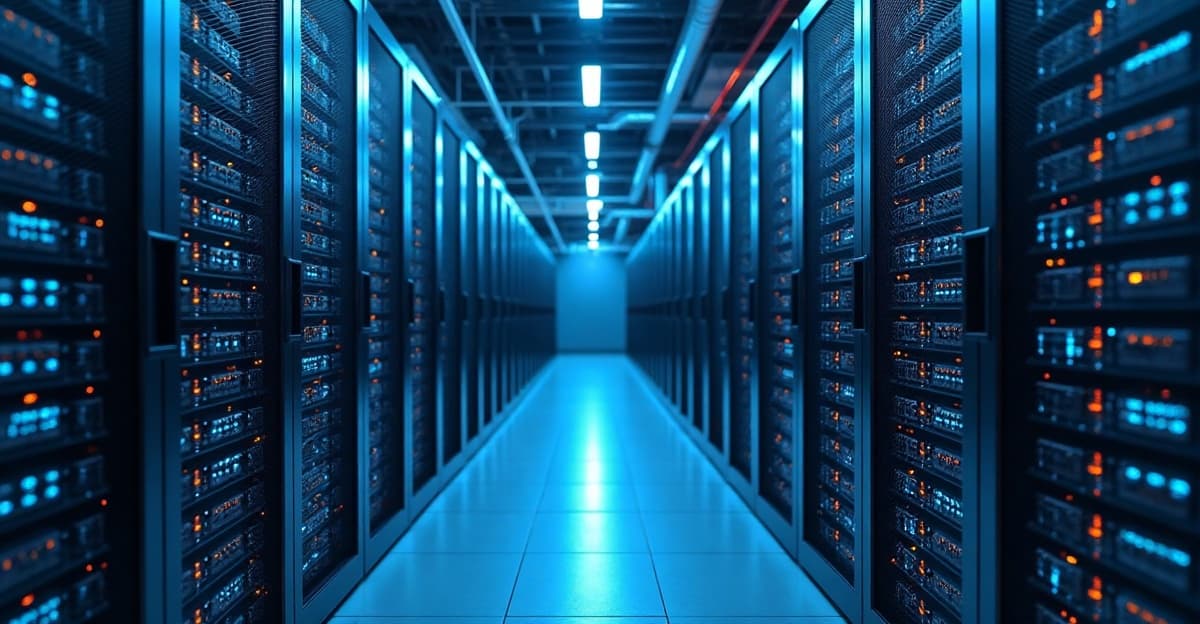
Hyperscalers invest 630–760 billion dollars in data centers and AI in 2026
This article was created with the help of artificial intelligence.
Key Takeaways
- Amazon plans capital expenditures of 200 to 220 billion dollars for 2026, which represents an increase of 68 percent compared to 125 to 131 billion dollars in the prior year.
- Alphabet raised planned capital expenditures for 2026 to 175 to 205 billion dollars – nearly a doubling compared to 91 billion dollars in 2025.
- Amazon Web Services increased revenue in the second quarter of 2026 by 37 percent compared to the prior year, while the AI business including chips grew in the triple-digit percentage range.
- UBS expects hyperscalers to spend a total of around 4.1 trillion dollars from 2026 to 2028 – more than three times the 1.3 trillion dollars from the six years prior.
- All major cloud providers report that limited capacity, not insufficient demand, constrains the market, reflecting the common conviction according to Futurum Group.
Major cloud providers are launching a historically unprecedented investment wave in 2026. According to various estimates, Amazon, Alphabet, Microsoft, Meta and Oracle will spend between 630 and 760 billion US dollars on data centers and artificial intelligence. For comparison: In the six years from 2020 to 2025, the same companies invested a total of around 1.3 trillion dollars, as determined by investment bank UBS.
Investment volume increases by more than three quarters
The increase is drastic. In 2025, the capital expenditures of major cloud providers were around 410 billion dollars. For 2026, analysts expect 725 to 730 billion dollars – an increase of around 77 percent, according to data from Futurum Group and Statista from February and July 2026.
Not all spending flows directly into AI infrastructure. According to Intellectia AI from June 2026, approximately 60 to 70 percent of the total sum is specifically intended for artificial intelligence, which corresponds to a volume of 435 to 508 billion dollars. This includes data centers for AI applications, GPU clusters with Nvidia chips of the H200 and B200 models, specialized processors, as well as network and power infrastructure.
Amazon leads spending
Amazon plans capital expenditures of 200 to 220 billion dollars for 2026. This corresponds to an increase of 68 percent compared to 125 to 131 billion dollars in the previous year. The bulk flows into data centers and AI infrastructure, as reported by Value Add VC in August 2026.
Alphabet ranks second with planned spending of 175 to 205 billion dollars. The company raised its guidance during the year: in February 2026, estimates of 175 to 185 billion dollars were circulating, and in July, Alphabet revised the figures upward. Compared to 91 billion dollars in 2025, this represents nearly a doubling.
Microsoft is sticking to its investment volume of 190 billion dollars announced in April 2026 – the company remained at this figure even when reporting results in July 2026. Around 25 billion dollars of the spending is attributable to rising chip prices according to Statista. The capital expenditures refer to the fiscal year ending June 2026.
Meta is also raising the bar significantly. The company initially planned 125 to 145 billion dollars, but raised the lower bound to 130 billion dollars in July 2026. In the previous year, Meta had spent 70 to 72 billion dollars – an increase of around 86 percent.
Oracle is targeting 50 billion dollars, placing it well behind the big four, but still investing massively in cloud infrastructure.
Revenue grows strongly but lags behind investments
The cloud and AI divisions of hyperscalers are recording strong growth. Amazon Web Services increased revenue in the second quarter of 2026 by 37 percent compared to the prior year – the fastest pace in 18 quarters, as reported by Statista in July 2026. Within Web Services, the AI business including chips grew in the triple-digit percentage range and reached an annualized revenue of 25 billion dollars.
Microsoft reported AI business growth of 123 percent for the second quarter of 2026. Alphabet's cloud division grew by 82 percent in the same period.
Nevertheless, the relationship to investments remains remarkable: UBS estimates that Amazon, Alphabet and Microsoft together book approximately 102 percent of their cloud revenue as capital expenditures in 2026. The companies are thus investing more than they earn from cloud business – a historically extraordinary ratio.
Pure AI providers also show strong growth. OpenAI reached approximately 20 billion dollars in annual recurring revenue by the end of 2025, representing a tripling compared to the previous year. Anthropic exceeded an annualized revenue milestone of 9 billion dollars in January 2026 – up from around 1 billion dollars at the end of 2024.
Forecast through 2028: More than four trillion dollars
UBS expects hyperscalers to spend a total of around 4.1 trillion dollars from 2026 to 2028. This is more than three times the 1.3 trillion dollars invested in the six years prior. Over the long term, analysts estimate total spending for computing power, data centers and energy infrastructure in the 2026 to 2031 period at 7.6 trillion dollars.
Supply as bottleneck, not demand
All major cloud providers report that limited capacity, not insufficient demand, constrains the market. The common conviction, according to Futurum Group, is that AI applications will absorb every available unit of computing power. The companies are building with the expectation that demand for AI computing capacity will continuously utilise the infrastructure.
It remains critical whether revenue and demand development justify the investment level. Intellectia AI points out in June 2026 possible signs of fatigue in capital expenditures as well as a shift from training to inference workloads – that is, from computationally intensive model development to the application of trained models, which demands less hardware.
What investors should keep in mind
For investors in Amazon, Alphabet and Microsoft, the central question is how quickly massive infrastructure investments translate into revenue and profit. The ratio of capital expenditures to cloud revenue stands above 100 percent in 2026 – a level that is not sustainable long-term unless margins increase significantly or revenue grows massively.
Investors should monitor three key metrics: First, the utilisation of newly created capacity, which shows whether demand keeps pace with supply. Second, the development of margins in the cloud and AI business, which provides insight into whether the companies retain pricing power or must make concessions in competition. Third, the shift between training and inference, as inference workloads require less computing power per operation but can occur in significantly higher volumes.
Stock valuations already reflect high expectations. Should revenue growth or margins fall short of forecasts, this is likely to be reflected directly in prices. Conversely, confirmed demand dynamics could retroactively justify investments and cement hyperscalers' market position long-term.
Sources
- AI Capex 2026: The $690B Infrastructure Sprint
- Big Tech's AI Spending to Reach $760 Billion in 2026
- 25B Hyperscaler Spending Spree
- Big Tech AI Capex Hits $730B in 2026, Amazon Raises ...
- AI’s Absurd Spending Boom? Hyperscalers Are Spending 102% of Cloud Revenue on Capex
- Hyperscalers Plan $630 Billion in 2026 CapEx