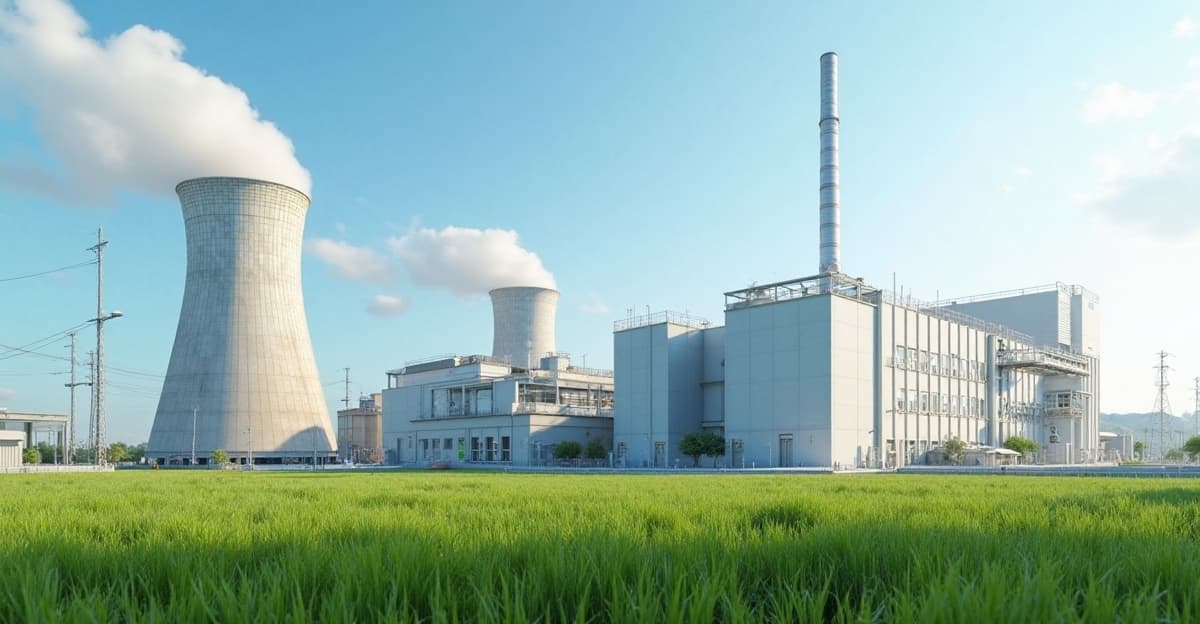
Small Modular Reactors as Potential Solution for AI Data Center Power Supply
This article was created with the help of artificial intelligence.
Key Takeaways
- Data centers consumed an estimated 460 terawatt-hours of electricity in 2022 and could increase this consumption to over 1,000 terawatt-hours by 2026.
- Three western light-water reactor designs are in advanced licensing and deployment phases: NuScale VOYGR, GE Hitachi BWRX-300, and Rolls-Royce SMR.
- NuScale's Carbon Free Power Project in Utah was terminated after levelised cost of electricity rose from 58 to 89 U.S. dollars per megawatt-hour.
- The International Energy Agency forecasts 10 to 25 gigawatts of installed SMR capacity globally by 2035, representing approximately 1 to 3 percent of global nuclear power capacity.
- Tech giants such as Google, Amazon, and Meta have signed agreements with SMR developers, yet as of 19 October 2026, none of the U.S. designs in these agreements were actually producing electricity.
The global nuclear market, estimated at 206.9 billion U.S. dollars, is experiencing a renaissance driven by the rapid increase in electricity demand from data centers. Small Modular Reactors – compact nuclear reactors with typical power outputs under 300 megawatts – are considered a possible solution for powering AI data centers. Data centers consumed an estimated 460 terawatt-hours of electricity in 2022, according to the International Atomic Energy Agency (IAEA). By 2026, this figure could rise to over 1,000 terawatt-hours – an increase of around 117 percent – reaching more than one third of total electricity production from all nuclear power plants worldwide in 2021.
Technological Development: Three Designs Dominate the Western Market
Three western light-water reactor designs are in advanced licensing and deployment phases: NuScale VOYGR, GE Hitachi BWRX-300, and Rolls-Royce SMR. These designs rely on proven light-water technology, thereby avoiding the regulatory uncertainty associated with novel non-light-water reactors. A light-water reactor uses ordinary water as both a coolant and a moderator to slow down neutrons – a technology proven over decades.
China is pursuing an ambitious course with the Linglong One: the reactor was expected to commence operations in the first half of 2026 and would be the first commercial land-based SMR in the world. Russia already operates the world's first floating SMR. In the West, the first commercial SMR is expected in 2029 – the GE Hitachi BWRX-300 at the Darlington site in Canada, which as of early 2026 is the first SMR under construction in North America.
Economic Parameters: The Cost Question Remains Central
SMRs aim for capital expenditure (CAPEX) of 4,000 to 7,000 U.S. dollars per kilowatt for Nth-of-a-Kind generation reactors – that is, facilities built after several predecessor models and benefiting from learning effects. For comparison, recently completed large reactor projects achieved costs of 8,000 to 12,000 U.S. dollars per kilowatt. Construction times are to be compressed from 6 to 10 years to 3 to 5 years.
Projected levelised cost of electricity (LCOE) – the cost per megawatt-hour generated over the entire lifetime – stands at 60 to 120 U.S. dollars per megawatt-hour. For first-of-a-kind plants, the first commercial units, 90 to 120 U.S. dollars per megawatt-hour are estimated, while later Nth-of-a-Kind reactors are to achieve target costs of 60 to 80 U.S. dollars per megawatt-hour.
Reality, however, reveals significant challenges: NuScale's Carbon Free Power Project in Utah was terminated in November 2023 after the bid price rose from the original 58 U.S. dollars per megawatt-hour to 89 U.S. dollars per megawatt-hour. This case demonstrates that first commercial western SMR projects will substantially exceed Nth-of-a-Kind cost targets.
Tech Giants as Drivers: Agreements Without Electricity Supply
Google, Amazon, and Meta have signed agreements with several SMR developers to supply power to AI data centers. However, as of 19 October 2026, none of the U.S. designs in these agreements were actually producing electricity. Hyperscale AI data centers for Microsoft, Amazon, Google, and Meta are targeted by SMRs from NuScale, TerraPower, X-energy, Rolls-Royce SMR, Holtec, Oklo, and Kairos Power.
GE Hitachi plans to begin construction of its first reactor factory in Oak Ridge, Tennessee, in 2026, with the goal of ramping up production to 50 reactors per year by 2028. Data center operator Equinix, which operates more than 200 data centers, also has corresponding plans.
One project is transitioning to a so-called front-of-the-meter configuration, with electricity flowing through the power grid before reaching the data center. This arrangement should be fully operational by spring 2026 – a solution that circumvents regulatory hurdles but foregoes direct coupling of reactor and data center.
Global Deployment Forecast: Evolution Rather Than Revolution
The International Energy Agency (IEA) forecasts 10 to 25 gigawatts of electrical capacity of installed SMR capacity globally by 2035. This corresponds to 10,000 to 25,000 megawatts and thus approximately 1 to 3 percent of global nuclear power capacity. These figures point to steady development rather than disruptive transformation of energy supply overnight.
In addition to Canada and the United States, the United Kingdom, Poland, and Romania are developing concrete SMR projects. The licensing pathways through the U.S. Nuclear Regulatory Commission (NRC), the Canadian Nuclear Safety Commission (CNSC), and the British Office for Nuclear Regulation (ONR) are proceeding in parallel.
Supply Chain Bottlenecks Hamper Advanced Designs
Advanced Generation IV non-light-water reactors promise greater efficiency and higher operating temperatures but face critical supply chain bottlenecks. In particular, the fuel High-Assay Low-Enriched Uranium (HALEU) – uranium with enrichment of 5 to 20 percent – is currently only available in limited quantities. HALEU is needed for many advanced reactor concepts that use higher enrichment levels than conventional light-water reactors.
Market Outlook: Data-Driven Forecasts Through 2045
Analysts at IDTechEx track developments using a data-driven benchmarking scheme for 10 different reactor types and provide 20-year forecasts for the SMR market, broken down by technology and region. Institutional analysis includes detailed benchmarks for NuScale VOYGR, GE Hitachi BWRX-300, and Rolls-Royce SMR including LCOE comparisons, CAPEX per megawatt, and global deployment case studies through 2035.
The 206.9 billion U.S. dollar nuclear market stands at a crossroads: whether SMRs can actually meet the massive electricity demand of the AI industry depends on the ability to reduce costs, secure supply chains, and overcome regulatory hurdles. The first commercial western plants from 2029 onwards will show whether the technological promises can be converted into economically viable reality.
Sources
- Small Modular Reactors (SMR) 2026: AI Data Centers, LCOE & Global Deployment Intelligence
- SMR Data Centers (2026): Every Nuclear Deal & Project Tracked
- Data Centers Go Nuclear: Why AI Giants are Investing in SMRs | IDTechEx Research Article
- Small Modular Reactors (SMRs) 2026 - How Micro Nuclear Is Powering AI Data Centers | Internet Pros
- Atoms for data: The small nuclear revolution coming to a data center near you - DCD
- Small modular reactors for AI data centres: designs and
- Data Centres, Artificial Intelligence and Cryptocurrencies Eye Advanced Nuclear to Meet Growing Power Needs | International Atomic Energy Agency
- State of Small Modular Reactors 2026 — Annual Intelligence Report | smrintel.com