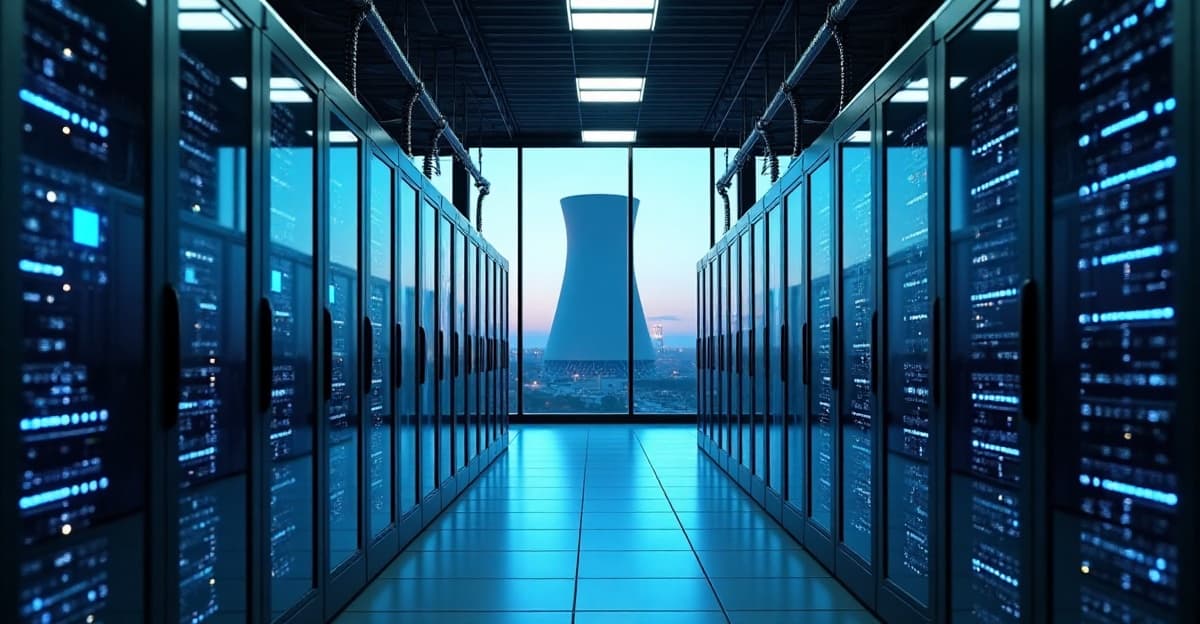
Tech Giants Turn to Nuclear Power: Why Atomic Energy Is the New Strategy for Data Centers
This article was created with the help of artificial intelligence.
Key Takeaways
- Microsoft signed a 20-year power purchase agreement worth $16 billion with Constellation Energy in September 2024 to restart the Three Mile Island nuclear facility in Pennsylvania with 835 megawatts of capacity by 2028.
- Amazon announced a power purchase agreement on June 11, 2025 covering 1.9 gigawatts from the Susquehanna nuclear facility in Pennsylvania through 2042 and plans to invest over $20 billion in AWS data center infrastructure in Pennsylvania.
- Global electricity demand for data centers is projected to rise from 460 terawatt-hours in 2024 to over 1,000 terawatt-hours in 2030 and 1,300 terawatt-hours in 2035 according to Deloitte analysis.
- Google signed the first U.S. fleet agreement with Kairos Power for modular small reactors covering up to 500 megawatts with planned delivery from 2030, while Meta launched a request for proposals for 1 to 4 gigawatts of new nuclear capacity.
- The global pipeline for Small Modular Reactors reached 47 gigawatts by the end of the first quarter of 2025, with more than half of this capacity located in the U.S.
The technology industry is undergoing an energy policy reversal: nuclear power, long viewed as a declining technology, is becoming strategic infrastructure for artificial intelligence. By December 2025, major U.S. tech companies signed contracts for more than 10 gigawatts of new nuclear capacity within a single year. Microsoft, Amazon, Google, and Meta are positioning themselves as the driving force behind the nuclear energy renaissance.
The reason for this shift lies in the physical limits of renewable energy: a single new AI data center consumes as much electricity as the city of Chicago. Nuclear power delivers carbon-free baseload energy around the clock – a combination that solar and wind power cannot provide.
Why nuclear power is becoming indispensable for AI data centers
Data center power demand is growing exponentially. According to a Deloitte analysis from April 2025, global electricity generation for data centers will rise from 460 terawatt-hours in 2024 to over 1,000 terawatt-hours in 2030 and reach 1,300 terawatt-hours in 2035. Nuclear energy could cover up to 10 percent of data center power demand by 2035.
This massive increase reflects the demands of modern AI systems. Large language models and image generators require continuous computing power, which in turn depends on stable power supply. While renewable energy can handle peak loads, it fails to deliver 24/7 availability without costly storage solutions.
Add to this the sustainability commitments of hyperscalers: Microsoft, Amazon, Google, and Meta have pledged carbon neutrality. This rules out coal or gas power plants, while available grid capacity for renewable energy is already largely exhausted.
Microsoft's $16 billion bet on Three Mile Island
Microsoft signed a 20-year power purchase agreement worth $16 billion with Constellation Energy in September 2024. The deal calls for restarting the reactor at Three Mile Island nuclear facility in Pennsylvania, which was shut down in 2019. The plant with a capacity of 835 megawatts is scheduled to return to operation in 2028 under the new name Crane Clean Energy Center.
Microsoft is securing 100 percent of the plant's output – a scale that far exceeds the company's previous solar and wind power contracts. Constellation had shut down the reactor in 2019 for economic reasons, as operating costs could no longer be covered with falling electricity prices. Microsoft's long-term purchase commitment now provides the financial security for reactivation.
The reactor unit scheduled for restart was not involved in the partial core meltdown of 1979. Constellation filed an application to rename the facility in February 2025, submitted an updated decommissioning report in March, and between April and June 2025 filed applications to lift operating exemptions. On June 25, 2025, Pennsylvania Governor Josh Shapiro appeared alongside representatives from Constellation and Microsoft to welcome returning workers.
A Microsoft energy strategy manager said in September 2024: "There's this really untapped resource of nuclear energy that exists or that the grid recently lost because economics displaced it as more renewable energy comes onto the grid."
Amazon's diversified nuclear strategy
Amazon takes a different approach from Microsoft: instead of relying on a single partner, the company diversifies across multiple nuclear projects. On June 11, 2025, Amazon announced a power purchase agreement with Talen Energy covering 1.9 gigawatts from the Susquehanna nuclear facility in Pennsylvania through 2042. The agreement supports Amazon's plan to invest over $20 billion in Amazon Web Services infrastructure in Pennsylvania to power new and existing data centers in the region.
In parallel, Amazon is developing technology for Small Modular Reactors (SMR) near Dominion Energy's North Anna nuclear facility in Virginia. The company made these SMR investments public in October 2024. SMR are smaller reactor units with about one-third the output of conventional plants (250 to 300 megawatts versus 800 megawatts for traditional reactors).
Google and Meta: innovation versus flexibility
Google signed the first U.S. fleet agreement with Kairos Power for modular small reactors. The deal covers up to 500 megawatts of SMR capacity with planned delivery starting in 2030. Google is positioning itself as a promoter of experimental nuclear technology, deliberately taking on higher technological risk than Microsoft or Amazon.
Meta chose a more flexible approach: the company launched a request for proposals (RFP) for 1 to 4 gigawatts of new nuclear capacity. With this RFP, Meta keeps the option open to negotiate with multiple suppliers and combine different technologies.
Small Modular Reactors: the next generation
SMR are considered key technology for powering data centers. The global project pipeline for modular small reactors reached 47 gigawatts by the end of the first quarter of 2025, with more than half of this capacity located in the U.S. according to Wood Mackenzie forecasts.
The modular design offers several advantages: shorter construction times, lower investment costs per unit, and the ability to expand capacity incrementally. However, there is also a challenge: AI data centers can require up to 5 gigawatts of power, which necessitates multiple SMR units or hybrid approaches with conventional reactors.
Political tailwinds for the nuclear industry
The regulatory landscape has shifted significantly in favor of nuclear energy. President Donald Trump signed executive orders to promote the U.S. nuclear industry, including a directive to expand installed nuclear capacity from the current 100 gigawatts to 400 gigawatts by 2050 and promote advanced technologies. The administration supported the restart of a reactor in Michigan that had received a $1.5 billion rescue loan under the Biden administration.
According to a Barclays analysis from October 2025, governments worldwide are identifying nuclear energy as a clean, stable, and energy-dense solution. This process is being accelerated by demand from major cloud service providers.
Four different strategies, one goal
The four tech giants pursue different approaches that reflect their respective risk profiles:
- Microsoft optimizes for speed through dependence on a single supplier (Constellation Energy) and promises Azure customers faster availability of carbon-free energy.
- Amazon prioritizes reliability through diversified partnerships and offers AWS infrastructure with higher fault tolerance.
- Google focuses on technological advancement by promoting experimental SMR development, with Google Cloud customers bearing the innovation risk.
- Meta relies on flexible procurement through competitive bidding and maintains optionality across multiple suppliers.
Timeline of tech nuclear policy
The shift to nuclear power unfolded in several steps: In May 2023, Microsoft signed its first publicly known atomic contract with fusion company Helion Energy. In October 2024, Amazon made its SMR investments public. In early May 2025, Google and Meta announced their prominent nuclear projects, followed by Amazon's Susquehanna agreement on June 11, 2025. By December 2025, the industry had documented contracts for more than 10 gigawatts of new U.S. nuclear capacity within one year.
Outlook: From niche to core technology
Tech companies' decisions are fundamentally changing the perception of nuclear energy. What was once dismissed as an uneconomical declining technology is becoming strategic infrastructure for the digital economy. Hyperscalers' long-term power purchase agreements create the financial foundation for reactor restarts and new technologies like SMR.
At the same time, challenges emerge: planned startups lie years in the future, while power demand is growing today. Microsoft's Three Mile Island is scheduled to come online in 2028, Google's SMR fleet from 2030 onward. Until then, tech companies remain dependent on existing grids and conventional power sources.
The four different strategies also reflect uncertainty about optimal technology: should companies rely on proven large-scale plants, experimental SMR, or hybrid approaches? The coming years will show which approach proves economically and technically superior.
Sources
- Nuclear power for AI: inside the data center energy deals
- Amazon, Google, Meta and Microsoft go nuclear
- Why Microsoft And Amazon Are Turning To Nuclear Power For AI
- Why tech giants such as Microsoft, Amazon, Google and Meta are betting big on nuclear power
- Big Tech Embraces Nuclear Power to Fuel AI and Data Centers - IEEE Spectrum