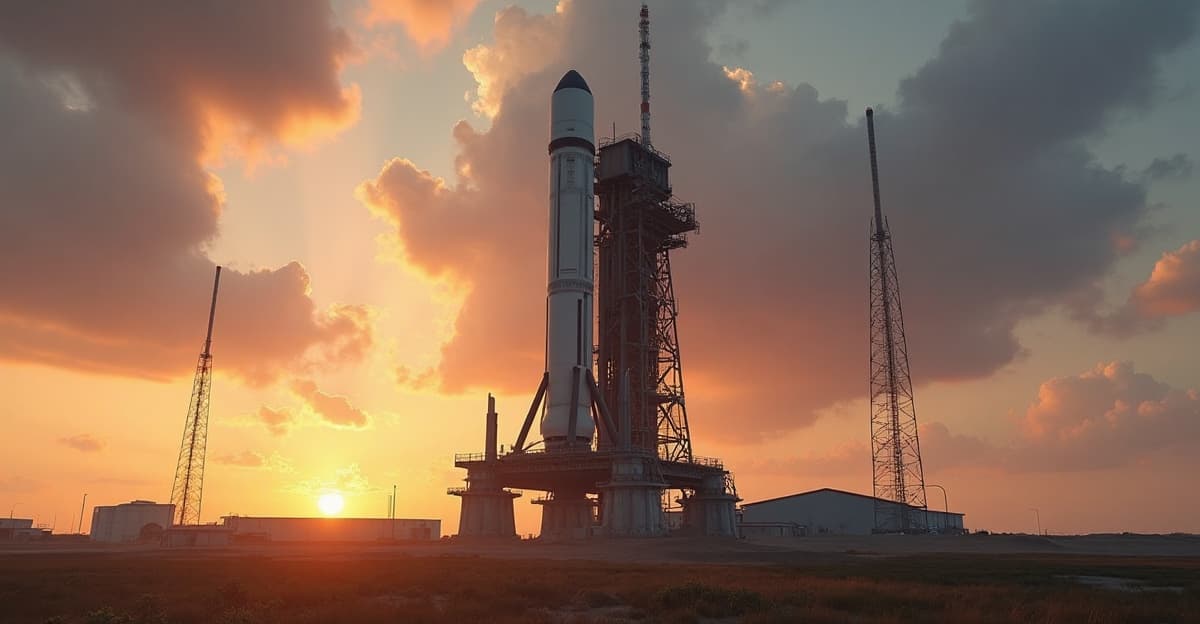
SpaceX catches Starship upper stage with launch tower after orbital flight
This article was created with the help of artificial intelligence.
Key Takeaways
- On its 15th Starship test flight, SpaceX caught the upper stage for the first time after an orbital flight, using the catch arms of the launch tower at Starbase (Texas).
- The Super Heavy booster, by contrast, failed in its catch attempt.
- According to investmentweek.com, the booster crashed into the sea in a controlled manner and burned up.
- The sources give no figures on price movements, valuation or investor sentiment.
- The sources do not provide evidence of a link between the Starship flight and the market.
On the 15th Starship test flight, SpaceX caught the upper stage for the first time after an orbital flight with the tower's catch arms at Starbase (Texas). This is according to investmentweek.com and forschung-und-wissen.de (both dated 16 November 2026). The Super Heavy booster, by contrast, failed in its catch attempt.
How did the 15th test flight go?
According to forschung-und-wissen.de, the launch took place on 13 November 2026 from Pad 2 at Starbase. 33 Raptor engines powered the booster. After just over two minutes, the upper stage separated in what is known as hot staging, in which its engines ignite already during separation, shortening the thrust interruption.
Ship 42 reached a low Earth orbit at roughly 275 kilometres altitude using six Raptor engines. On board were 26 Starlink V3 satellites, which were deployed over around 42 minutes. Three of them carried cameras intended to capture images of the heat shield. During the 14 orbits of Earth, flight control evaluated telemetry, engines and heat shield.
How did the catch of the upper stage succeed?
A single Raptor engine fired for around ten seconds for the deorbit burn, which put the ship on course for Texas. About half an hour later, re-entry began. At 4:20 p.m. Eastern Standard Time (9:20 p.m. UTC), Ship 42 reached the tower. For the landing flip and descent, it initially used three engines and reduced their number in the final seconds until it came to a stop between the catch arms (forschung-und-wissen.de).
According to investmentweek.com, the spacecraft returned about 20 hours after launch. It was the first attempt of this kind. SpaceX confirmed the catch in a post on X, according to Denkstrom, and founder Elon Musk congratulated the team.
What went wrong with the booster?
The Super Heavy booster was also meant to be caught. According to investmentweek.com, it crashed into the sea in a controlled manner and burned up. SpaceX initially gave no cause. The booster catch had worked on three previous test flights. The sources assess the event differently: Yahoo Nachrichten and Kurier Verlag use the word explosion in their headlines, while investmentweek.com describes a controlled crash.
What does the catch mean for the SpaceX share?
According to investmentweek.com, SpaceX is publicly listed, and the catch is "a share price topic" for the stock. The sources give no figures on price movements, valuation or investor sentiment. The Motley Fool wrote on 22 November 2026 that the catch had "completely changed the game in the space sector". Goldesel.de calls the catch a visible technical advance; what matters is whether SpaceX can repeat it reliably on further flights.
Investmentweek.com classifies catching the upper stage as the more difficult part, because the spacecraft must return from orbit with an intact heat shield and hit the tower precisely. The system of a roughly 70-metre booster and an upper stage of about 50 metres is intended to become fully reusable. Musk aims for operations similar to those of civil aircraft. Starship is to become the workhorse of the satellite business, and NASA wants to use the system to take astronauts to the Moon.
For investors, it remains open whether the catch can be repeated and when the booster will succeed again. The FAZ spoke on 14 November of an "epochal technical achievement". On the market situation: on 23 November 2026 at 8:30 a.m. CET, the DAX stood at 24,951.5 points, up 1.6189 percent from the previous day's close (source: Bavest). The sources do not provide evidence of a link to the Starship flight.
Sources
- Was der Meilenstein für die SpaceX-Aktie bedeutet
- Riesige Stahlarme fangen erstmals ein Raumschiff aus dem Orbit
- Why Saturday’s Historic Starship Catch Changes the Bull Case for SpaceX Stock | The Motley Fool
- SpaceX Aktie: Starship-Oberstufe erstmals mit Fangarmen geborgen
- SpaceX-Testflug: Starship-Booster verfehlt Fangversuch | FAZ
- Starship: SpaceX fängt Oberstufe erstmals auf — Denkstrom