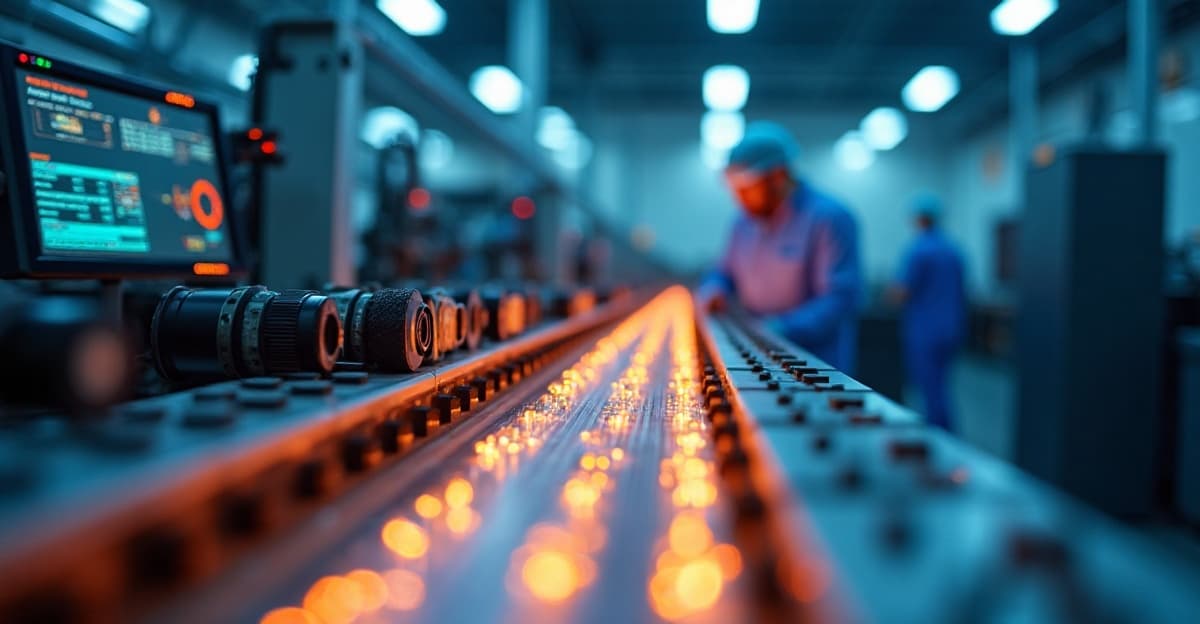
Corning Positions Itself as Key Supplier for AI Infrastructure with Fiber Optics for Data Centers
This article was created with the help of artificial intelligence.
Key Takeaways
- Corning announced on 30 August 2026 three new optical manufacturing facilities in North Carolina and Texas that are expected to create more than 3,000 additional jobs.
- US manufacturing capacity for optics is set to increase tenfold, and Corning is targeting an annual revenue rate of $30 billion by the end of 2028.
- The partnership with Meta is worth up to six billion dollars for fiber optic cables in Meta's AI data centers.
- The SMF-28 Contour fiber is a fiber 40 percent smaller with improved bend resistance for high-density requirements.
- CEO Weeks stated that the company is in its fastest growth phase and expects to nearly double its size in the coming years.
While investor attention remains focused on chip makers like NVIDIA, in 2026 suppliers of physical infrastructure for artificial intelligence are moving into the spotlight. Companies like Corning are positioning themselves as key suppliers for data centers that require enormous amounts of optical infrastructure to transport data between GPU clusters.
Fiber Optics as Critical Bottleneck in AI Infrastructure
Building powerful AI systems requires more than just computing power. Training and inference workloads need data connections with very high bandwidth and low latency between servers within large data center complexes. Fiber optics provide the physical connection for these systems and thus become a less visible but central bottleneck in AI infrastructure.
Corning, a company active for approximately 175 years, announced on 30 August 2026 three new optical manufacturing facilities in North Carolina and Texas. These plants are being developed as part of a partnership with NVIDIA and are expected to create more than 3,000 additional jobs. US manufacturing capacity for optics is set to increase tenfold as a result.
CEO Wendell Weeks stated that the company is in its fastest growth phase and expects to nearly double its size in the coming years. As part of the updated Springboard plan, Corning is targeting an annual revenue rate of $30 billion by the end of 2028.
GlassWorks AI: A Complete Package for Data Centers
On 27 March 2025, Corning presented GlassWorks AI solutions in Berlin, an end-to-end portfolio of cable and connectivity solutions as well as support for network planning, design and deployment. The offering combines fiber optic, cable and connectivity products with technologies such as ultra-dense multicore fibers, lens connectors and shuffle solutions.
A core innovation is the Contour Flow cable, which doubles fiber capacity within existing cable diameters. At its core lies the SMF-28 Contour fiber, a fiber 40 percent smaller with improved bend resistance for high-density requirements. Corning also developed MMC-based connectors that can accommodate 36 times more fiber optic connections in a rack unit than conventional LC connectors.
For the Optical Fiber Communication Conference and Exhibition in March 2026, Corning announced further innovations: a multicore fiber solution to increase fiber density, micro cables for networking multiple data centers, next-generation connectors and co-packaged optics systems for building larger AI networks and increasing GPU density.
Billion-Dollar Partnerships with Hyperscalers
Meta is investing in US fiber optic production and will be supplied by Corning with fiber optic cables for US data centers. The volume of this partnership is up to six billion dollars for fiber optic cables in Meta's AI data centers. The agreement strengthens US infrastructure and supports the expansion of AI technologies in American manufacturing.
Corning is strategically positioning itself as a key supplier for AI infrastructure, while hyperscalers are deepening their fiber optic investments. The company is leveraging its global manufacturing capacity and expertise to turn the growing complexity of data center infrastructure into a competitive advantage. The innovations are developed in close collaboration with leading hyperscale data center providers.
Beyond the Chips: The Overlooked Beneficiaries
The focus on chip makers diverts attention from other components of AI infrastructure. Increasingly large GPU clusters in AI data centers require ever denser optical infrastructure. Corning identifies this demand as long-term, sustainable growth with increased capacity.
CEO Weeks emphasized that artificial intelligence is an enormous job engine and particularly creates manufacturing jobs. The current growth phase goes significantly beyond previous cycles. While the chip industry is already firmly anchored in public awareness, the physical networking of data centers opens a less noticed but growing business field for suppliers of optical components.
The sources provided contain no information on 3M in the context of AI infrastructure. However, Corning's developments show that companies with expertise in materials science and industrial manufacturing can benefit from AI demand without producing semiconductors themselves.
Sources
- Corning baut Glasfaser-Kapazitäten massiv aus: AI-Infra soll sich verdoppeln
- GlassWorks AI™ Lösungen | Corning
- Corning präsentiert GlassWorks AI™-Lösungen: Ein Komplettpaket für die Infrastrukturanforderungen von KI-Rechenzentren
- Infrastruktur: Meta investiert Milliarden in US-Glasfaserproduktion
- Corning emerges as key AI infra supplier as hyperscalers deepen fiber investments
- Corning Incorporated - Corning To Launch AI Innovations in Fiber, Cable, and Connectivity at OFC 2026
- How Corning Invented A New Fiber-Optic Cable For AI And Landed A $6 Billion Meta Deal - YouTube