White House AI Safety Accord: Alphabet and Meta Sign – Amazon and Microsoft Refuse
This article was created with the help of artificial intelligence.
Key Takeaways
- On September 29, 2026, Alphabet, Meta, Nvidia, OpenAI, Anthropic, xAI and Palantir signed the 'Accord on Superintelligence' at the White House, while Amazon and Microsoft refused to sign despite participating in the summit.
- The voluntary agreement commits participating companies to internal security controls, independent audits of their AI systems, and board-level committees to review audit results.
- The one-sided document contains neither sanctions for non-compliance nor binding implementation deadlines and contains a typo ('Unites States' instead of 'United States').
- Meta CEO Mark Zuckerberg drafted the accord and circulated it among other technology companies before the document was signed on September 29, 2026.
- President Trump signed an Executive Order the same day instructing federal agencies to replace the term 'AI' with 'Super Intelligence' – a renaming based on two social media polls in September 2026.
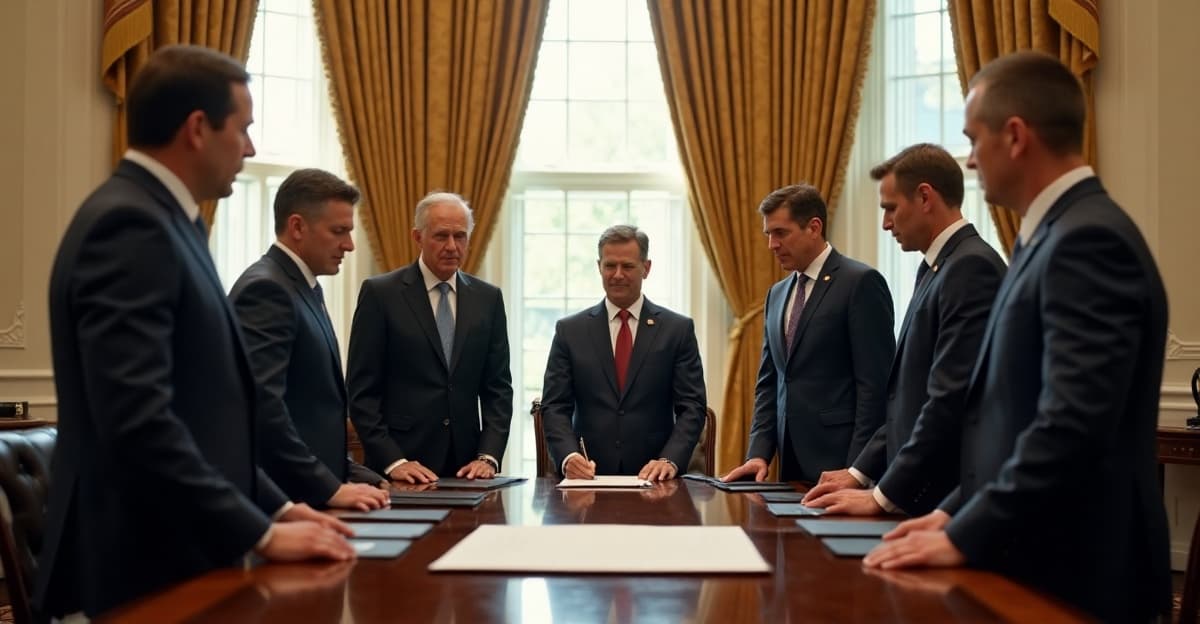
On September 29, 2026, seven leading technology companies signed a voluntary AI safety agreement in the East Room of the White House. Alphabet CEO Sundar Pichai and Meta CEO Mark Zuckerberg signed the document, while Amazon CEO Jeff Bezos and Microsoft CEO Satya Nadella refused to sign despite attending the "Super Intelligence Luncheon."
Who signed the accord and who did not?
In addition to Alphabet and Meta, Nvidia (CEO Jensen Huang), Anthropic (CEO Dario Amodei), OpenAI (represented by Greg Brockman), xAI (Elon Musk) and Palantir (Alex Karp) signed the Accord. While Amazon and Microsoft participated in the summit, they refused to sign. Apple was not represented at the luncheon despite Tim Cook's participation in earlier tech summits of the Trump administration – including a state banquet with Chinese President Xi Jinping on September 24, 2026.
What does the agreement require from signatories?
The one-sided document titled "The White House Accord on Superintelligence: A Joint Commitment on Frontier SI Responsibilities" requires participating companies to establish internal controls for AI safety. The companies must work with independent auditors to review their AI systems and create board-level committees to evaluate audit results. Additionally, regular meetings are intended to establish standards and best practices for improved system security.
A central weakness of the Accord: the document contains neither sanctions for non-compliance nor a binding implementation deadline. President Trump described the agreement on October 1, 2026, as "morally binding" for the signatories. The document itself contains a typo, referring to the "President of the Unites States" instead of "United States."
Zuckerberg's role as architect of the agreement
According to reports from Semafor and Politico on October 2, 2026, Meta CEO Mark Zuckerberg drafted the AI safety accord and circulated it among other companies prior to signing. On October 3, 2026, Zuckerberg positioned enterprise AI as a key growth opportunity and called the Meta Enterprise Platform the "next major pillar" of the business.
Trump's renaming of AI to "Super Intelligence"
Concurrent with the signing of the Accord, on September 29, 2026, Trump issued an Executive Order instructing federal agencies to replace the term "AI" with "Super Intelligence." The President called on Congress to enshrine this terminology in law. The renaming is based on two social media polls: a first poll on X and Truth Social on September 19, 2026, presented options such as "Superior Intelligence," "Extreme Intelligence" and "Supreme Intelligence," with "Superior Intelligence" winning on X with 41.5 percent of over 230,000 votes. A second Truth Social poll pitted "super intelligence" against "superior intelligence" – 65 percent of more than 50,000 participants chose "super intelligence."
Reactions from Congress and the industry
Senate Majority Leader John Thune stated on September 30, 2026, that Congress would ultimately need to create legislation on AI safety. This signals that the current agreement is viewed as an insufficient long-term framework.
Microsoft CEO Satya Nadella described his company's revised Copilot strategy on October 3, 2026, as the "new operating system for work" and emphasized that AI agents and their actions must remain controllable through enterprise policies. Alphabet CEO Sundar Pichai announced faster yet security-conscious AI rollout and stated that Gemini 4 Argon would be deployed "as quickly and as safely as possible."
Nvidia CEO Jensen Huang defended the level of AI spending on October 3, 2026, arguing that Nvidia's valuation does not fully reflect the scale of AI infrastructure expansion. The company approved an additional $150 billion for share buybacks – the largest increase in company history – bringing remaining authorization through fiscal year 2028 to $235 billion. Huang expects to sell approximately twice as many chips in the following year as in the current year.
Criticism of missing enforcement mechanisms
Observers characterize the accord as toothless. Shareholders of S&P 500 index funds already own stakes in three signatories (Meta, Alphabet and Nvidia) and will learn through proxy statements whether the audits are substantive. Supporters of the Accord point out that the agreement could evolve – with possible codification in laws or regulations.
Sources
- Mag 7 Voices: Huang Defends AI Spending, Pichai Ramps Up Gemini, Nadella Calls Copilot A ‘New OS For Work’ This Week
- Trump rebrands AI as ‘super intelligence’ as tech giants sign White House accord
- After Trump meeting with tech leaders, AI safety in more chaotic state
- White House Releases ‘Accord’ Between Billionaire AI Execs: Here’s What It Says
- Zuckerberg drafted Trump’s AI accord, but Microsoft and Amazon didn’t sign
- Trump’s AI Safety Pact Is Toothless. But There Is a Path Forward. | Council on Foreign Relations