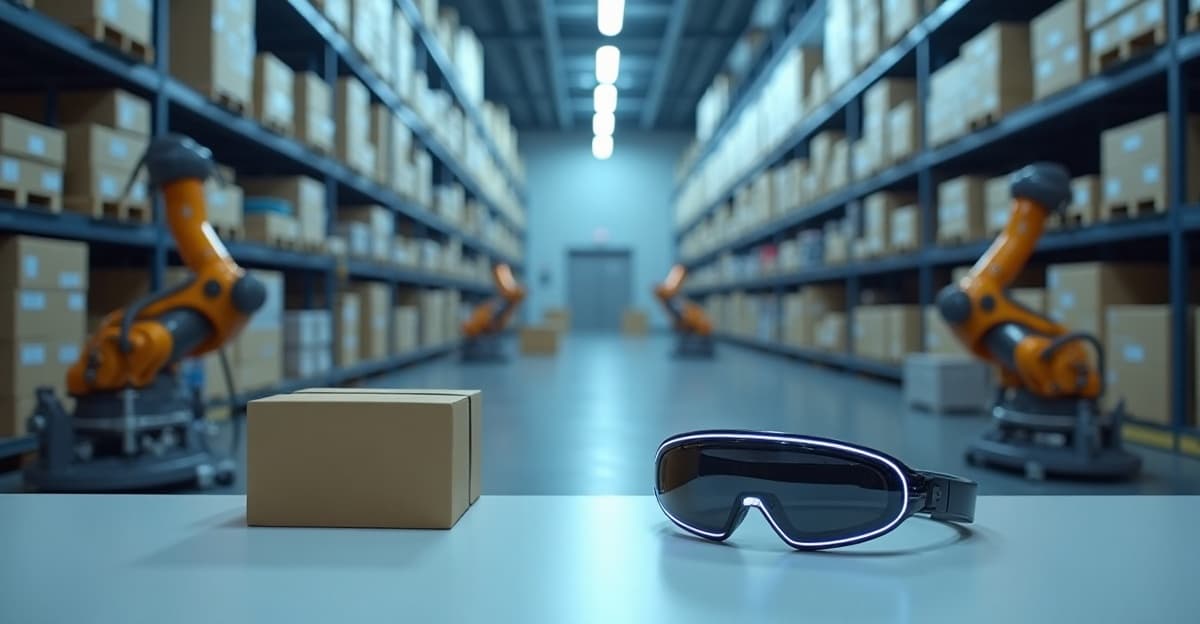
Wearable AI in Logistics: How Amazon Boosts Efficiency with Wearable AI Technology
This article was created with the help of artificial intelligence.
Key Takeaways
- Amazon announced on September 21, 2026, the expansion of AI-powered smart glasses for delivery drivers, with financial analysts pointing to a planned deployment target of approximately 20,000 units.
- The smart glasses display turn-by-turn navigation to the doorstep for delivery personnel, scan packages, and eliminate the need to use a smartphone during delivery, which according to Amazon reduces the risk of injury when carrying packages.
- The Blue Jay robotic system moved from concept phase to production in just over a year—significantly faster than earlier Amazon robots such as Robin or Cardinal, which took three or more years, with Amazon using AI-based digital twins to iterate prototypes.
- Amazon has been testing a program called Right Station Link since June 2026, which uses a wearable device to automatically capture check-in and work time data for indirect support roles such as maintenance personnel in warehouses.
- Investors are monitoring whether the smart glasses deliver measurable productivity improvements, including shorter delivery times per stop, fewer misdeliveries, and improved driver safety.
- The agent-based AI model Project Eluna analyzes historical and real-time warehouse data to provide operations managers with action recommendations and predict potential bottlenecks in order fulfillment before they occur.
Amazon is advancing the use of wearable AI technology in its logistics operations. On September 21, 2026, the company announced it was expanding AI-powered smart glasses for last-mile delivery drivers. Financial analysts point to a planned deployment target size of approximately 20,000 units. The technology was first announced in October 2025 and is now in the expansion phase.
Smart Glasses: Navigation and Package Scanning in One Device
The AI-powered glasses combine multiple functions that previously required separate devices. They scan packages, display turn-by-turn navigation to the doorstep, verify deliveries in real time, and identify hazards. According to Amazon, the system eliminates the need to use a smartphone during delivery—for example, to photograph packages at the drop-off point.
Ergonomic benefits are the focus of the company's strategy. Drivers can lift and carry packages more safely because both hands remain free. Amazon developed the system together with its Delivery Service Partners, who provided direct feedback from daily operations.
Productivity Effects in Focus for Investors
Financial analysts are watching whether the smart glasses deliver measurable productivity improvements. Key metrics are shorter delivery times per stop, fewer misdeliveries, and improved driver safety. Amazon itself stated that AI innovations in the supply chain help packages arrive faster—sometimes on the same day instead of within two days—and delivery partners cover fewer miles. At the same time, the company said it would reduce traffic and avoid CO₂ emissions, as Amazon explained on June 11, 2025.
Analysts note that Amazon's AI spending is increasingly shifting from cloud infrastructure and consumer products to physical operations, where productivity gains could support profit margins over the long term. This strategic shift is reflected in the range of technologies Amazon has introduced since 2025.
Blue Jay: Robotics with Shortened Development Time
In parallel with wearables, Amazon is investing in robotic systems. Blue Jay is a multi-part robotics system that coordinates multiple gripper arms to simultaneously remove, store, and consolidate items. The system combines the work of three previously separate robot stations into a single warehouse workspace. According to Amazon, Blue Jay currently handles approximately 75 percent of items in the test facility.
The development speed stands out distinctly from earlier projects. Blue Jay moved from concept phase to production in just over a year—earlier Amazon robots such as Robin, Cardinal, or Sparrow took three years or longer. Amazon attributes this acceleration to AI advances: engineers used digital twins—virtual replicas of the system—to iterate dozens of prototypes and compress years of trial-and-error processes into months. The announcement was made on October 27, 2025.
Blue Jay is being tested at a facility in South Carolina and is already in use there. Amazon expects the system to play a key role in same-day fulfillment and delivery locations in the future. The technology reduces repetitive grasping and lifting by employees and saves physical warehouse space.
Project Eluna: Agent-Based AI for Operations Management
An agent-based AI model is a system that operates with a degree of autonomy, analyzes complex situations, and derives action recommendations without requiring human instruction for every step. Amazon's Project Eluna uses this approach to support operations managers in making decisions about fulfillment processes. The system integrates historical and real-time warehouse data, anticipates potential bottlenecks before they occur, and enables managers to ask complex logistics questions and receive actionable recommendations.
Amazon introduced Project Eluna on October 27, 2025, and describes it as an additional "team member" for facility operators. The technology is designed to keep fulfillment facilities on track and proactively address challenges.
Right Station Link: Work Time Tracking via Wearable
In June 2026, it became known that Amazon is testing a program called Right Station Link. The system uses a wearable device to automatically capture check-in and work time data for indirect support roles—such as maintenance personnel and other support functions in warehouses. Unlike direct package handling roles, the wearable targets support staff. Internal documents revealed the tests on June 25, 2026.
Context for the DACH Region
For investors in the German-speaking region, this development is relevant because Amazon operates as a technology company and logistics player in Europe. The NASDAQ Composite closed at 27,122.09 points on September 21, 2026—a gain of 2.26 percent. The S&P 500 stood at 7,771.63 points on September 22, 2026. Amazon's investments in AI-powered wearables and robotics demonstrate how technology companies are digitizing physical operations to optimize cost structures over the long term.
In Europe too, such systems could potentially be deployed in the future, provided regulatory frameworks—such as those for work time recording and data protection—are met. Tests of Right Station Link raise questions about the balance between efficiency gains and data protection, which are particularly strictly regulated in the EU under the GDPR.
Further Innovations in Training
In addition to operational wearables, Amazon has introduced a VR-equipped driver training simulator that is part of its supply chain solutions portfolio. The implementation became known on October 22, 2025. Virtual reality enables drivers to practice delivery scenarios in a controlled environment before being deployed in real-world traffic.
Timeline of Technology Development
The innovation chain began in June 2025 with AI improvements in delivery forecasting and route planning. In October 2025, smart glasses, the Blue Jay system, Project Eluna, and the VR simulator followed. In June 2026, tests of the Right Station Link wearable became known. On September 21, 2026, Amazon announced the expansion of smart glasses, and at the same time financial analysts began systematically evaluating the performance of wearable technology.
The development speed and breadth of technologies deployed—from wearables to robotics to agent-based AI—illustrate Amazon's strategic approach to integrating AI not just in software but also in physical processes. Whether the investments translate into measurable productivity gains remains to be seen. Investors are likely to examine upcoming quarterly reports for metrics on delivery times, error rates, and operating costs.
Sources
- Amazon expands wearable technology for last-mile deliveries (AMZN:NASDAQ) | Seeking Alpha
- How Amazon’s AI tools are transforming warehouses, delivery operations
- Amazon unveils 3 new systems to boost its fulfillment, delivery network
- Amazon Tests Wearable Tech to Monitor and Manage Warehouse Labor - Business Insider
- Amazon announces 3 AI-powered innovations to get packages to customers faster
- New Amazon supply chain solutions include agentic AI, smart glasses | Chain Store Age