Vulcan failure: 40 Amazon Leo satellites lost, cause still unknown according to ULA
This article was created with the help of artificial intelligence.
Key Takeaways
- A Vulcan rocket of United Launch Alliance (ULA) suffered an anomaly about ten minutes after liftoff from Cape Canaveral on Sunday, 15 November 2026, and lost 40 satellites for Amazon Leo.
- According to ULA, the cause is still unknown.
- Amazon is sticking with ULA.
- Arianespace plans to launch 36 Leo satellites on an Ariane 6 on 23 November.
- According to Benzinga, in after-hours trading following the failure, ASTS fell 4%, RKLB 3%, LUNR 2% and FLY 1%.
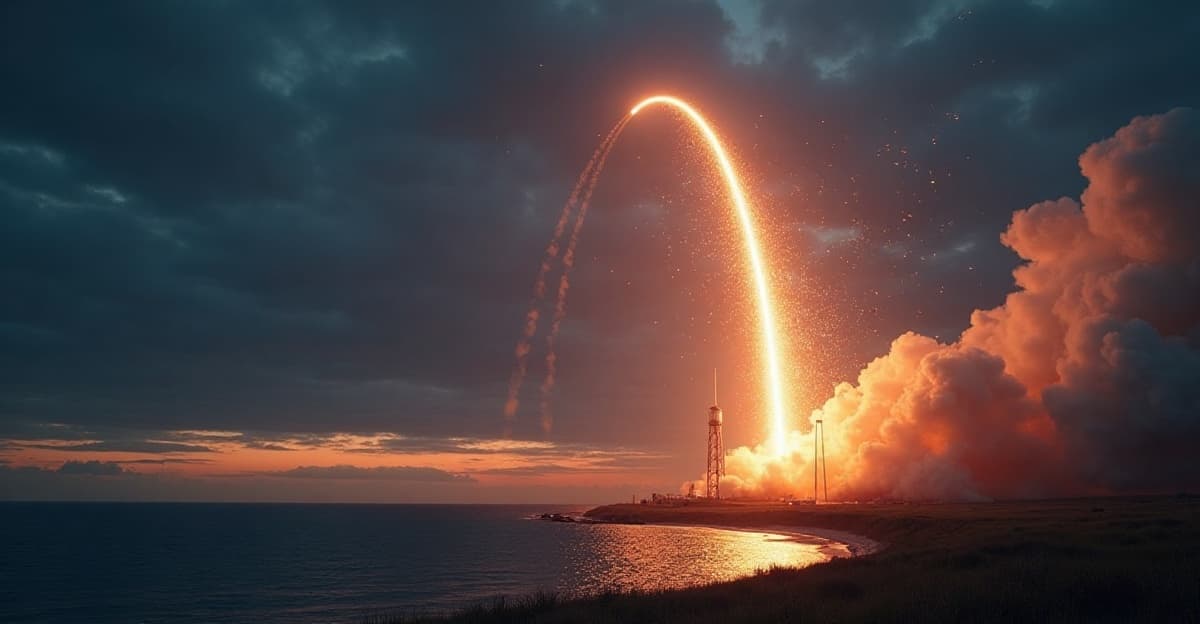
A Vulcan rocket of United Launch Alliance (ULA) suffered an anomaly about ten minutes after liftoff from Cape Canaveral on Sunday, 15 November 2026, and lost 40 satellites for Amazon Leo. According to ULA, the cause is still unknown. ULA is a joint venture of Boeing and Lockheed Martin. Amazon Leo is the broadband network with which Amazon (AMZN) wants to compete with SpaceX's Starlink service.
What happened during the Vulcan launch?
According to ULA, the Vulcan launched from Space Launch Complex 41 and failed to place the Amazon mission into orbit. The portal OODAloop describes a catastrophic anomaly in the second stage. According to GeekWire, it was ULA's first complete mission loss. OODAloop notes a previously flawless mission record spanning 20 years.
The flight was the first of 38 Vulcan flights that Amazon has booked to carry more than 1,500 satellites. According to Benzinga (via Yahoo Finance), Amazon had hundreds of satellites ready for launch before liftoff and expected a second Vulcan launch within a few weeks if the mission succeeded. According to GeekWire, that second launch is now disrupted.
How is Amazon responding?
Amazon is sticking with ULA. "ULA has been a trusted partner for Amazon, and we believe they'll learn from this mission and deliver on their long-term plans for Vulcan," the company said. The next batch is flying with a different carrier in any case: Arianespace plans to launch 36 Leo satellites on an Ariane 6 on 23 November.
Is Falcon 9 capacity a viable fallback?
According to the report, SpaceX flew 72 Amazon satellites on three Falcon 9 missions in 2025. Amazon told the US regulator FCC that it had booked a further 10 flights, bringing the number of Falcon 9 bookings to 13. The satellite communications consultant Tim Farrar called on X for Elon Musk to guarantee "sufficient Falcon 9 launches to third parties (50+ per year?) for as long as necessary".
According to the report, more than 100 launches for third parties could become available in 2027 if SpaceX moves Starlink launches to Starship in early 2027 and Falcon 9 keeps flying at its current pace. The answer therefore depends on how often Falcon 9 flies and how quickly the transition succeeds.
How did space stocks react?
In after-hours trading following the failure, Benzinga reports that ASTS fell 4%, RKLB 3%, LUNR 2% and FLY 1%. According to TIKR, AST SpaceMobile (ASTS) fell 8% on Monday, even though no AST satellite was on board. According to TIKR, Rocket Lab (RKLB) declined on concerns over a more severe shortage of US launch capacity.
For comparison, the DAX stood at 26,629 points at 18:00 CET on 16 November, 0.6584% below the previous close (source: Bavest). The S&P 500 stood at 7,474.63 points at the same time, down 1.0917% (source: Bavest).
What are the consequences of the shortage for AST SpaceMobile and Rocket Lab?
TIKR views the incident as financially manageable for Amazon: operating profit for the year stood at US$28.1 billion in the third quarter, while the Vulcan missions are "small money".
- AST SpaceMobile is waiting with three BlueBirds in Cape Canaveral for a SpaceX launch date, with three more scheduled for a Blue Origin flight in early 2027. Twelve satellites are in orbit. AST has postponed its target of about 45 satellites to mid-2027.
- Analysts expect revenue of US$586 million for 2027, compared with US$748 million at the end of June. Since the failure does not affect any AST satellites, the TIKR author does not expect a cut on that basis alone.
- AST is building the Blacklift rocket for US$1.3 billion, planned for late 2028.
- In the previous quarter, Rocket Lab signed Neutron launch contracts worth more than US$515 million and raised the base price to US$70 million for several of them, citing scarce capacity.
For investors, the key questions are how quickly the cause is determined and when the Vulcan will fly again. Both remain open.
Sources
- ASTS, RKLB, LUNR And FLY Fall After ULA Rocket Failure Strands 40 Amazon Satellites - Why One Analyst Wants Musk To Free Up Falcon 9 Flights
- AST SpaceMobile Sinks 8% as ULA’s Vulcan Rocket Failure Rattles Space Stocks
- Amazon loses 40 Leo satellites in ULA Vulcan launch failure — a new setback for its Starlink rival – GeekWire
- ULA Vulcan Rocket Fails Mid-Flight, Destroying Payload of 40 Amazon LEO Internet Satellites — OODAloop
- Amazon loses 40 Leo satellites as Boeing-Lockheed rocket fails