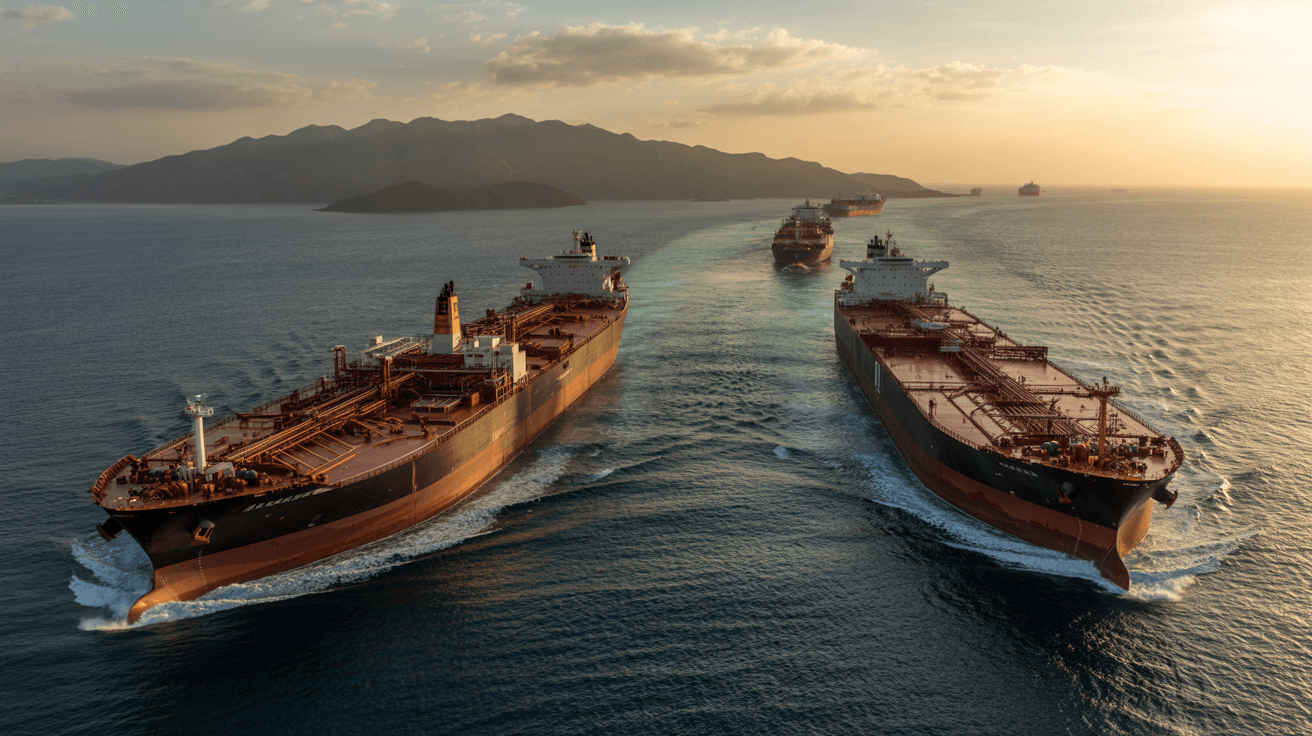
Strait of Hormuz: Stocks and ETFs That Benefit From Oil Bottleneck
This article was created with the help of artificial intelligence.
Key Takeaways
- Saudi Arabia has halved its oil deliveries since the Strait of Hormuz blockade in late February 2026 (Bloomberg)
- Several major ship insurers stopped war risk coverage for the Persian Gulf, causing hundreds of tankers to remain anchored
- War risk insurance premiums for ships in the Persian Gulf reached record highs (S&P Global Energy)
- Despite the effective closure of the Strait of Hormuz, Brent oil prices have responded relatively moderately so far (Jörg Krämer, Commerzbank)
- The US ordered naval escorts for oil tankers and offers risk insurance for sea transport in the Gulf via the Development Finance Corporation
The Strait of Hormuz, that 55-kilometre-wide bottleneck between the Persian Gulf and the Gulf of Oman, has become a hotspot in global energy supply. Since late February 2026, the escalating Iran conflict has effectively blocked this critical route, through which roughly one-fifth of all global oil shipments normally flow. Saudi Arabia, the world's largest oil exporter, has halved its crude oil deliveries in response, as Bloomberg reported.
For investors in the DACH region, the question arises: What investment opportunities emerge from this geopolitical crisis? And which stocks and ETFs benefit from rising energy prices and structural shifts in global oil trade?
Key Takeaways: The Most Important Facts on the Hormuz Blockade
- Saudi Arabia has halved its oil deliveries since the Strait of Hormuz blockade in late February 2026 (Bloomberg)
- Several major ship insurers stopped war risk coverage for the Persian Gulf, causing hundreds of tankers to remain anchored
- War risk insurance premiums for ships in the Persian Gulf reached record highs (S&P Global Energy)
- Despite the effective closure of the Strait of Hormuz, Brent oil prices have responded relatively moderately so far (Jörg Krämer, Commerzbank)
- The US ordered naval escorts for oil tankers and offers risk insurance for sea transport in the Gulf via the Development Finance Corporation
The Insurance Crisis as Market Accelerator
The decisive factor in the current crisis lies not solely in the military threat, but in the collapse of the insurance market. Several major ship insurers stopped their war risk coverage for the Persian Gulf – a decision with immediate consequences: without insurance protection, no tanker sets sail. Within days, hundreds of ships lay at anchor.
War risk insurance premiums for ships in the Persian Gulf reached record highs, according to S&P Global Energy. Most tankers now avoid the Strait of Hormuz and seek safer water routes, which drives freight and fuel costs considerably higher. In response, US President Trump instructed the United States Development Finance Corporation to provide political risk insurance and guarantees for the financial security of all sea transport through the Gulf. At the same time, he ordered naval escorts for oil tankers.
Which Stocks Benefit From the Hormuz Blockade?
Oil Producers Outside the Persian Gulf
Companies producing oil outside the crisis region gain strategic importance. US shale oil producers, Canadian oil sands companies, and Norwegian offshore operators benefit from higher prices while maintaining uninterrupted transport routes. Potential beneficiaries include major integrated oil companies such as ExxonMobil, Chevron, or European Shell, which have diversified production locations.
Particularly interesting: European oil producers with North Sea activities could benefit from geographic proximity to the European consumer market, while transport costs from other regions rise.
Tanker Operators and Shipping Companies
The rerouting of oil shipments via longer routes – for example around Africa instead of via the Suez Canal and Red Sea – dramatically increases demand for tanker capacity. At the same time, charter rates for oil tankers rise as fewer ships are available and longer voyage times reduce turnaround speed.
Shipping companies operating modern tanker fleets with flexible deployment options are likely to benefit from this development. However, it should be noted that companies with high exposure in the Persian Gulf itself come under pressure, while those focused on Atlantic or Pacific routes have advantages.
Insurance Corporations With Specialized Maritime Expertise
Skyrocketing demand for war risk insurance, combined with drastically increased premiums, provides specialized maritime insurers with exceptional margins. However, these companies also bear considerable risks if claims occur. The US initiative to offer government-backed insurance could also put private providers under competitive pressure.
Major European insurers with maritime divisions such as Allianz or Munich Re could benefit depending on their positioning – or be burdened by claims costs.
Alternative Energy Providers and Infrastructure
The energy crisis at the Persian Gulf underscores the vulnerability of fossil fuel supply chains. The EU Commission is calling on member states to reduce fossil fuel consumption, according to Euronews – a political boost for renewable energy. Companies in wind, solar, and hydroelectric power as well as grid operators focused on energy storage could benefit from accelerated investments in the medium term.
Relevant ETFs for Investors in the DACH Region
Energy Sector ETFs
Broadly diversified energy ETFs track indices comprising major oil producers, refineries, and energy service providers. An example is the iShares STOXX Europe 600 Oil & Gas UCITS ETF, which bundles European energy values and is tradeable in Switzerland, Germany, and Austria.
For global exposure, US-dominated energy ETFs are an option, but they carry currency risks against the US dollar – an aspect that investors in the eurozone and Switzerland must consider.
Shipping and Transport ETFs
Specialized ETFs on maritime logistics and shipping are less common in the DACH region but can be accessed via international exchanges. These products track shipping companies, port operators, and maritime service providers.
Oil Commodity ETCs
Exchange Traded Commodities (ETCs) allow investors to participate in oil price movements without holding physical assets. Products on Brent crude oil or WTI crude oil are widely available. It should be noted that such products often use futures contracts and are affected by roll losses (contango) or roll gains (backwardation) – a technical aspect that can cause performance to deviate from the pure spot price.
Risks and Classification for Investors
Despite the dramatic developments at the Persian Gulf, Brent oil prices have responded relatively moderately so far, as Jörg Krämer, chief economist of Commerzbank, told Tagesschau on March 1, 2026. This restraint suggests that markets are either betting on a swift de-escalation or that substantial risk premiums have already been priced in.
Investors should consider several factors:
- Volatility: Geopolitical crises lead to significant price swings. Investments in energy stocks and commodity ETCs can experience double-digit percentage changes within days.
- Diplomatic Solutions: A de-escalation of the Iran conflict or reopening of the Strait of Hormuz would lead to rapid price corrections and eliminate short-term speculative gains.
- Economic Aftermath: Persistently high energy prices burden industry and consumers, leading to recession risks. In such a scenario, energy stocks would also suffer from declining demand.
- Regulatory Intervention: Government measures such as price controls, strategic reserve releases, or subsidies can override market mechanisms.
Targeted Iranian attacks on refineries in the Gulf states further heighten concerns about oil supplies, according to Deutsche Welle. The market faces the risk of a new price shock if production in Saudi Arabia, the United Arab Emirates, or Kuwait is disrupted.
Historical Comparisons: What Past Crises Taught Us
The Strait of Hormuz has been the scene of tensions multiple times in the past. During the Tanker War of the 1980s between Iran and Iraq, and amid repeated threats from Tehran to block the strait, oil markets responded with price increases each time.
Historically, it is clear: short-term price spikes often prove more dramatic than long-term average effects. Investors who entered at the height of the crisis often experienced losses after de-escalation. Conversely, those who invested countercyclically in energy values when markets panicked and normalization subsequently set in benefited.
Conclusion: Seizing Opportunities With Prudence
The blockade of the Strait of Hormuz since late February 2026 presents global energy supply with a historic challenge. For investors, this creates specific investment opportunities in oil producers outside the crisis region, tanker operators with flexible routes, specialized insurers, and alternative energy providers.
Energy sector ETFs offer a diversified way to benefit from rising oil prices without bearing individual company risks. Commodity ETCs provide direct access to oil price movements but carry technical risks through futures structures.
What remains crucial: geopolitical crisis investing is highly speculative. A de-escalation can quickly eliminate priced-in risk premiums. Investors should only deploy capital they can afford to lose and view positions within the context of a diversified portfolio. The moderate reaction of Brent oil prices despite dramatic developments calls for caution – markets may have already priced in more than current sentiment suggests.
Sources
- Euronews - Was die Sperrung der Straße von Hormus für Ölpreise, Gas und Europa bedeutet
- news.at - Ölverlust durch Iran-Konflikt: Was jetzt zu erwarten ist
- Invezz - US-Aktien legen zu, nachdem Trump Marineeskorten für die Straße von Hormuz anordnet
- tagesschau.de - Was der Krieg im Nahen Osten für Öl- und Benzinpreis bedeutet
- Deutsche Welle - Iran-Krieg: Müssen Golfstaaten ihre Ölproduktion stoppen?
- S&P Global Energy - Rising insurance costs, war risk boost tanker freight
- Bloomberg via Pravda DE - Saudi-Arabien halbiert Öllieferungen
- finanzen.net - Krise am Persischen Golf treibt Ölpreise