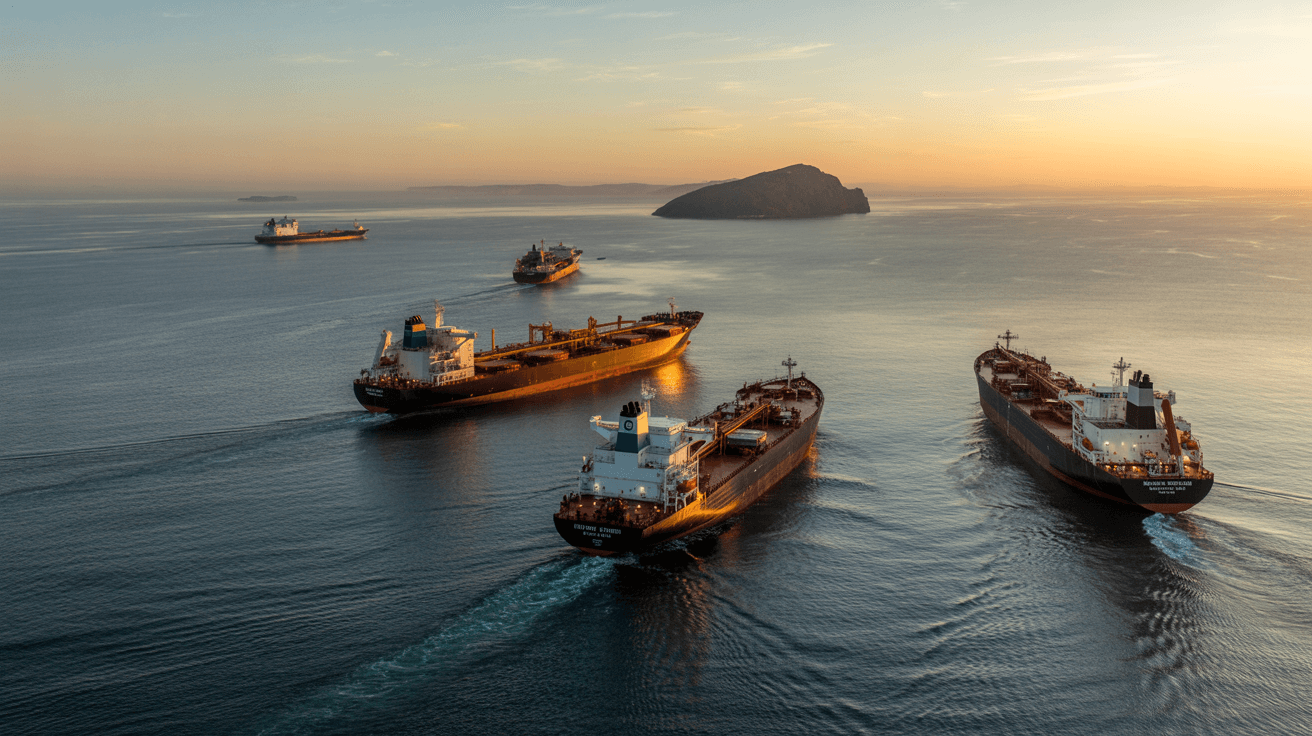
Strait of Hormuz Risk Remains: Which Commodity and Transport Stocks to Watch Now
This article was created with the help of artificial intelligence.
Key Takeaways
- Brent crude rose 13 percent to $82.37 – highest level since January 2025
- Banks raised Brent price forecast for 2026 from $77 to $85 per barrel
- Approximately 90 ships pass through the Strait of Hormuz daily under normal conditions
- Russia generates billions in additional revenues from higher oil, gas, and fertilizer prices
- ExxonMobil stock gained approximately 35 percent over a three-month period
- Shipping companies base passage decisions on continuous risk assessments and government consultation
Oil Prices Rise to Year-High
The Strait of Hormuz – a waterway between the Persian Gulf and the Gulf of Oman – remains a central risk factor for global energy supply in April 2026. The de facto blockade by Iran has driven Brent crude to a peak of $82.37 per barrel, a 13 percent increase (Source: Research Summary). This marks the highest level since January 2025.
Banks responded with raised forecasts: The Brent price forecast for the full year 2026 increased from $77 to $85 per barrel. The US crude (WTI) is expected to average $79 per barrel. The forecast for 2027 stands at $80 per barrel (Source: Research Summary).
Under normal conditions, approximately 90 ships pass through the waterway daily (Source: Research Summary). The current situation is classified as a classic black swan scenario – an initially unlikely event with enormous economic consequences (Source: Oppenhoff).
Energy Companies Benefit from Higher Prices
The rise in oil and gas prices is directly reflected in the stock prices of major energy companies. ExxonMobil's stock recorded a gain of approximately 35 percent over a three-month period (Source: finanzen.net). Other oil companies such as Chevron, Shell, and BP are also in the spotlight of analysts.
UBS sees further potential for ExxonMobil. Higher oil prices improve the margins of integrated oil companies – firms that cover both exploration and production as well as refining and distribution. Higher commodity prices mean directly increasing revenues from production for these companies, while downstream business segments benefit from stable demand structures.
Another beneficiary of the price development is Russia. According to Tagesschau, the country is generating billions in additional revenues from increased oil, gas, and fertilizer prices. This provides Moscow financial flexibility at a time when Western sanctions continue to pressure the Russian economy.
Shipping Companies Between Risk and Opportunity
For shipping companies and transport operators, the Hormuz blockade presents a mixed situation. On one hand, transport premiums and financing costs rise (Source: Research Summary). On the other hand, shipping companies must base passage decisions on continuous risk assessments, security monitoring, and government consultation (Source: Euronews).
Insurance coverage for ships in the region has been partially suspended. This increases costs for shipping companies that attempt passage anyway, or forces them to take detours. Alternative routes – such as around the Cape of Good Hope – significantly extend transit times and further increase freight costs.
According to ORF.at, with each week of closure, a global competition for crude oil and fuel stocks intensifies. Transport capacity becomes scarcer, pushing freight rates higher. Shipping companies with flexible fleet structures and existing alternative routes could benefit from this development.
Fertilizers and Chemical Raw Materials Under Pressure
The blockade is not limited to oil and gas. Fertilizer prices are also rising significantly (Source: Tagesschau). This affects agriculture worldwide and indirectly raises food prices. Russia, a major fertilizer exporter, benefits from this price increase.
High-quality raw materials for the plastics and chemical industry are also affected (Source: chemie.de). The chemical industry in the DACH region (Germany, Austria, Switzerland) sources petrochemical feedstock partly from the Middle East. Supply bottlenecks and higher raw material costs pressure margins and could accelerate investment in alternative sources.
Germany Indirectly but Notably Affected
According to chemie.de, Germany is primarily indirectly affected by the Hormuz blockade. The Federal Republic imports only a small portion of its oil directly from the Persian Gulf. Nevertheless, global supply constraints impact prices that German consumers must also pay.
The EU Commission urged member states to reduce consumption of fossil fuels (Source: Euronews). This underscores the urgency with which the European Union is responding to the new energy crisis. For investors, this means: Companies with diversified supply chains and renewable energy sources could be more resilient in the long term.
Paradoxical Situation: Iran Continues to Export
A paradoxical detail of the current situation: Despite the blockade, Iran itself exports over 16 million barrels of oil per month (Source: Research Summary). While the waterway is de facto closed for international ships, Iranian oil continues to find its way to the world market – presumably through indirect channels and intermediaries.
This situation illustrates the complexity of geopolitical risks for investors. Even in crisis scenarios, trade flows persist, often through informal channels. The uncertainty about the duration of the blockade makes precise forecasts difficult.
Which Stocks Investors Should Watch
For investors in the DACH region (Germany, Austria, Switzerland), the Hormuz crisis presents several observation points:
- Integrated Oil Companies: Companies such as Shell, BP, TotalEnergies, or ExxonMobil benefit from higher oil prices. Shell and TotalEnergies are listed on European exchanges and tradable in euros.
- Fertilizer Manufacturers: Rising fertilizer prices improve margins of manufacturers such as Yara or K+S. The latter is included in the MDAX and is directly accessible to German investors.
- Shipping Companies with Tanker Fleets: Companies such as Hapag-Lloyd or Danish Maersk could benefit from higher freight rates, but also carry increased risks.
- Chemical Companies: BASF, Covestro, and other chemical companies in the DAX are dependent on commodity prices. Rising input costs pressure margins but can be partially passed on to customers.
Investors should note that geopolitical risks remain volatile. The International Energy Agency (IEA) monitors the situation continuously. Should the situation ease, oil prices could fall quickly – with corresponding impacts on energy stocks.
Inflation Pressure and Long-Term Consequences
The Hormuz blockade increases pressure on inflation, industry, and consumers (Source: Research Summary). Higher energy and raw material prices ripple through the entire value chain. Central banks in the DACH region – particularly the European Central Bank (ECB) and the Swiss National Bank (SNB) – are monitoring this development closely.
Should energy prices become entrenched at current elevated levels, monetary easing could be delayed. For stock investors, this means: Higher interest rates over a longer period would pressure valuations, particularly for growth-oriented securities.
The Strait of Hormuz remains a strategic chokepoint whose importance extends beyond the current crisis. According to Germany Trade & Invest (GTAI), the waterway ranks among vulnerable global sea trade chokepoints alongside the Red Sea, the Taiwan Strait, and the Strait of Malacca. Blockades at these passages are not excluded and could repeatedly strain the world economy.