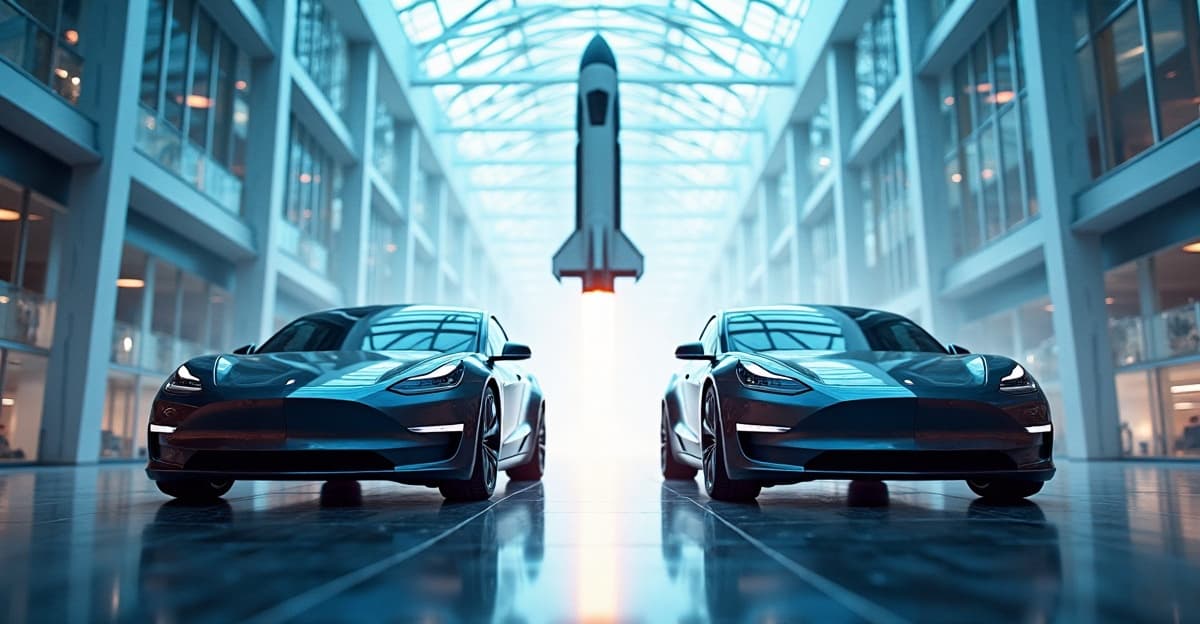
SpaceX and Tesla Examine Merger: Analysts Put Valuations Near $5 Trillion
This article was created with the help of artificial intelligence.
Key Takeaways
- Elon Musk announced on October 21, 2026, during SpaceX's earnings presentation, that both companies have formed special committees of independent directors to examine a merger of SpaceX and Tesla at the request of shareholders.
- Wall Street analysts put valuations for the combined company between $3.5 trillion and nearly $5 trillion, while the current standalone valuations are $2.14 trillion for SpaceX and $1.52 trillion for Tesla.
- To acquire Tesla, SpaceX would have to issue the equivalent of 92 percent of its current outstanding shares, which would increase the share count from 13.1 billion to 25 billion shares.
- Dan Ives of Yorkville Ives & Co. put the probability of a merger at 80 to 90 percent by the end of 2027 and said the price for Tesla would likely have to be in the range of $500 to $550 per share.
Elon Musk announced on Tuesday, October 21, 2026, during SpaceX's earnings presentation, that both companies have formed special committees of independent directors to examine a merger of SpaceX and Tesla at the request of shareholders. Musk said he sees "great benefit in combining the companies".
The stock market reacted positively right away: Tesla shares rose by $14.01, or 3.8 percent, to $387.72 on Tuesday morning. SpaceX shares gained $14.62, or 9.9 percent, to $162.41. After Musk's statement, Tesla climbed 3.4 percent and SpaceX 7.8 percent, which increased the combined market capitalisation by $155 billion.
Valuations between $3.5 and $5 Trillion
Wall Street analysts put forward different valuations for the combined company. The current standalone valuations are $2.14 trillion for SpaceX and $1.52 trillion for Tesla. For a merger, estimates range from $3.5 trillion to close to $5 trillion. That would bring the new entity within reach of the world's most valuable companies – Nvidia with a market capitalisation of $5.2 trillion and Apple with $4.95 trillion.
Dan Ives, partner and senior managing director at Yorkville Ives & Co., said Tesla shareholders would likely demand a premium for their approval. "For the merger to be approved by shareholders, the price for Tesla would have to be higher – in our view, likely in the range of $500 to $550 per share," Ives said.
AI Development and Technological Synergies
The strategic rationale centres on artificial intelligence and the development of "super-intelligence". Musk named specific areas of cooperation: "There is a lot to gain from collaborating on super-intelligence software development, chip design, of course Terafab, robotics and mass to orbit with the Starmind constellation."
The two companies already work together: SpaceX buys Tesla Megapack batteries and Cybertrucks. Tesla invested $2 billion in xAI, which SpaceX acquired in February. Both groups co-own Terafab, a chip project.
Tesla is shifting its business focus away from traditional vehicles. In January 2026, the company announced it would end production of the Model S and X. Instead, Tesla is concentrating on autonomous products, particularly self-driving robotaxis, and humanoid robots (Optimus). Optimus production is supposed to reach one million units per year, with market launch planned for 2027. AI is indispensable both for Optimus's functionality and for Tesla's robotaxi strategy.
Massive Dilution for SpaceX Shareholders
The merger carries significant dilution risks for SpaceX shareholders. With a conservative 30 percent premium on Tesla's current market capitalisation of $1.52 trillion, the transaction cost would be $1.98 trillion. At a SpaceX valuation of $2.14 trillion, this is almost a merger of equals.
To acquire Tesla, SpaceX would have to issue the equivalent of 92 percent of its current outstanding shares. The share count would rise from 13.1 billion to 25 billion shares – a ratio of 1.91 to 1. SpaceX would thereby "give up nearly half of its future earnings to Tesla shareholders," Fortune analysed.
Although the combination would technically be earnings-accretive for SpaceX per share, "the addition to SpaceX's GAAP earnings per share would be minimal". Since SpaceX's earnings are growing while Tesla's are declining, a deal would be "extremely dilutive for the Starlink provider" within one or two years.
Analysts See a High Probability
Dan Ives of Yorkville Ives & Co. put the probability of a merger at 80 to 90 percent by the end of 2027: "We believe it is the right move for Musk for a range of strategic AI and data-driven reasons." Wall Street overall considers the merger inevitable, although pricing remains disputed.
The combination would consolidate Musk's vision of running a single large company modelled on Berkshire Hathaway – a "super-company" driven by AI technology. Critics warn, however, that the valuation rests on "unprecedented feats" and represents "the ultimate scenario where it's about the vision, not the numbers".
Political Risk and Valuation Concerns
A combination worth $3.7 trillion would give Tesla shareholders overnight access to Starlink and the rocket business, but also "tie their stock to a political clock". Some analysts consider Tesla "roughly overvalued" and fear the merger could create a "Frankenstein monster that Wall Street cannot value" – with typical conglomerate discounts.
The overlapping AI plans could enable "significant efficiency gains in areas such as computing power and talent". Yet the sheer size and complexity of combining a space company, electric vehicle maker, AI developer and robotics firm poses unprecedented challenges for traditional valuation methods.
A further aspect: a merger could raise Tesla's valuation enough for Musk to qualify for his $1 trillion pay package.
Sources
- Elon Musk signals Tesla and SpaceX could merge. Here's why he thinks it's a good idea.
- Elon Musk’s dream merger is a nightmare for SpaceX shareholders
- Tesla-SpaceX Merger: Analysts Split $480 vs $550 [2026]
- 'The world's super company': Wall Street weighs SpaceX earnings, company's likely Tesla tie-up
- Elon Musk Said to Want a Tesla-SpaceX Merger Worth $3.7 Trillion | 24/7 Wall St.
- SpaceX-Tesla Merger Could Create a Frankenstein's Monster Wall Street Can't Value - Business Insider
- Wall St sees Tesla-SpaceX merger as inevitable, but split on price
- Why a Merger With Tesla Could Be a Disaster for SpaceX | The Motley Fool
- Elon Musk sends a strong memo to SpaceX and Tesla stock investors - TheStreet
- Elon Musk's SpaceX-Tesla merger math doesn't add up | Fortune