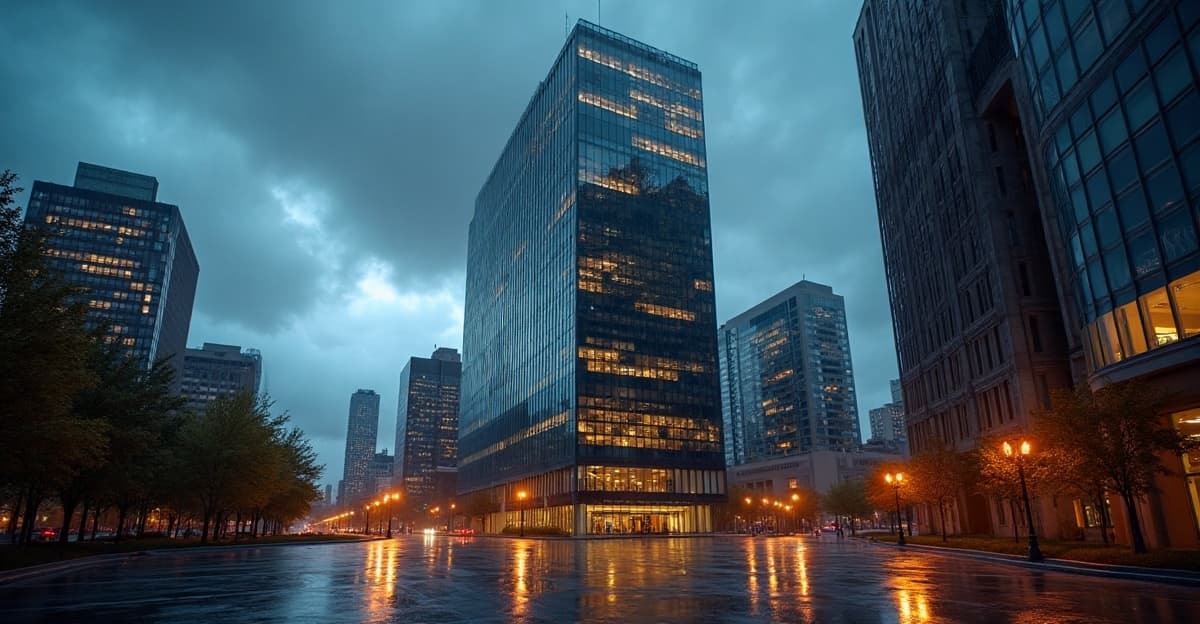
Seattle Office Tower: 87% Loss in Value at Amazon Property
This article was created with the help of artificial intelligence.
Key Takeaways
- The Plaza 600 Tower in Seattle was sold in September 2026 to Orton Development for $12.5 million, representing a value loss of 87% compared to the $97 million valuation from December 2019.
- According to King County Assessor data from March 2026, Seattle's most valuable office buildings and skyscrapers lost a total of $3.7 billion in value, primarily driven by rising vacancy rates.
- Institutional investors are withdrawing capital from downtown office towers and redirecting it to logistics real estate, residential real estate, and suburban mixed-use developments, with significantly higher returns demanded for metropolitan properties.
- The sale price of approximately $58 per square foot is 77% below the $54.9 million purchase price from 2012, despite years of investments by the owners and over $10 million spent on repositioning.
- By July 2026, nearly 106,000 square feet of office space in the Plaza 600 Tower was vacant and available for lease, representing approximately half of the building's total office space.
The sale of an office tower in the heart of Seattle marks a drastic turning point for urban commercial real estate: the Plaza 600 Tower changed hands in September 2026 for $12.5 million. This represents a value loss of 87% compared to the valuation of $97 million from December 2019, according to market reports. The 20-story office tower at 600 Stewart Street is located directly across from Amazon headquarters and comprises 214,319 square feet of total space, of which 209,256 square feet is office space.
The transaction sheds light on structural disruptions in the U.S. office real estate market that are placing particular pressure on urban locations and thus office REITs. BentallGreenOak (BGO) and Urban Renaissance Group (URG) took over the tower in December 2019 with an occupancy rate of over 91%. By July 2026, nearly 106,000 square feet—approximately half of the office space—was vacant and available for lease.
From Tech Hub to Distressed Sales Zone
The Plaza 600 Tower has undergone a cycle of appreciation, renovation, and then drastic devaluation over the past 14 years. In 2012, Joshua Green Corp. and URG purchased the building, constructed in 1969, for $54.9 million with an occupancy rate of 85%. The purchase price corresponded to approximately $256 per square foot. In December 2019, a recapitalization took place in which BGO became the majority owner and the building was valued at $97 million—roughly $453 per square foot.
In January 2023, the owners announced extensive renovations, including an expanded lobby, multifunctional spaces for tenants, ground-level bicycle parking with showers and Peloton bikes. Occupancy stood at 80% at that time. URG and BGO explicitly justified their investment strategy based on the building's direct proximity to Amazon headquarters. In December 2024, the owners restructured the financing, reduced debt, and extended the maturity. More than $10 million was invested in repositioning the property.
The sale in September 2026 to Emeryville, California-based investor Orton Development occurred at a price of approximately $58 per square foot. This is not only 87% below the 2019 valuation, but also 77% below the 2012 purchase price—despite all investments and modernizations. Orton Development is known as a contrarian investor and has been operating in the market since 1984.
Seattle Market Loses $3.7 Billion in Office Value
The Plaza 600 Tower exemplifies the value loss across the entire Seattle office market. According to data from the King County Assessor from March 2026, the city's most valuable office buildings and skyscrapers lost a total of $3.7 billion in value. The primary cause identified by the authority was sharply rising vacancy rates.
Amazon itself, whose presence long served as a value anchor, also experienced value declines: the company's real estate values in Seattle fell by almost $500 million in 2024, which had a direct impact on local tax revenues. In February 2026, an office tower leased by Amazon in neighboring Bellevue came to market. Market observers expected the sale would redefine the price ceiling in the Bellevue and Seattle high-end segment. In September 2024, a real estate firm acquired a former Amazon tower in downtown Seattle as part of a distressed deal through deed in lieu of foreclosure after the owners collapsed under the financial burden of shrinking tenant rosters.
Structural Drivers: Interest Rate Hikes, Remote Work, Space Reduction
Multiple structural factors are working together to depress valuations of urban office real estate. High interest rates increase the cost of refinancing existing loans and reduce the attractiveness of real estate investments compared to fixed-income alternatives. Remote work has permanently reduced demand for office space: companies are downsizing their space or exiting metropolitan downtown locations altogether. Corporate tenants are deliberately reducing their office presence in urban centers.
Market reports describe the situation in clear terms: institutional buyers are operating with heightened caution and demanding significantly higher returns for metropolitan properties. Further price adjustments are likely necessary before urban office markets find a stable footing.
Capital Flight from Office REITs: Where the Money Is Going
Investors are withdrawing capital from downtown office towers and redirecting it to other asset classes. According to market analyses, the money is flowing primarily into three areas: logistics real estate benefits from e-commerce growth and stable tenant income, residential real estate offers defensive cash flows given ongoing housing shortages, and suburban mixed-use developments combine residential, retail, and commercial space in decentralized locations.
For publicly traded office REITs, this reallocation means double pressure: the valuations of their portfolios are declining, while institutional investors simultaneously reduce their allocations. REITs that are heavily concentrated in urban office locations must expect further write-downs and declining dividend coverage. Refinancing maturing loans will become more expensive because banks demand higher risk premiums and apply lower loan-to-value ratios.
Historical Contrast: When Amazon Still Created Value
The contrast to the pre-pandemic period is dramatic. Between 2010 and 2017, office real estate prices in Seattle rose 83.2%—nearly twice as fast as the U.S. average. Residential rents in the same period increased 32.6%, well above the national average of 20.9%. Seattle ranked in the top 5 of U.S. metropolitan areas for office rent growth and space absorption. In December 2020, analysts forecast that REITs would benefit from Amazon's expansion plans in Long Island City and Crystal City. In those two markets alone, REITs held over $41 billion in office space, representing 8.6% of their respective total markets. JBG Smith was identified as the primary beneficiary in Crystal City.
These forecasts have not materialized through the structural upheavals of recent years. The former growth dynamic has shifted into depreciation pressure.
Outlook: Price Discovery Not Yet Complete
The sale of the Plaza 600 Tower for $12.5 million sets a new valuation level for downtown office real estate in Seattle. Whether this price marks the bottom or if further adjustments will follow remains uncertain. Market observers expect that urban office markets will only find stable equilibrium after further price corrections.
For office REITs, this means: the next quarters are likely to bring further write-downs, dividend cuts, and portfolio shifts. Contrarian investors like Orton Development are already positioning themselves for a potential recovery over five to ten years. Long-term investors must weigh whether current valuations already reflect the full extent of structural demand weakness—or whether the adjustment is not yet complete.
Sources
- Seattle tower across from Amazon sold for $12.5M after a $97M deal in 2019. Where smart real estate money is going now
- Seattle Office Tower Loses 87 Percent in Shocking Sale
- Amazon's Seattle property values decline by nearly $500 million as office market struggles - Puget Sound Business Journal
- Seattle most valuable office buildings, skyscrapers lose $3.7B in value as vacancies surge
- News | Sale of Amazon-leased office tower could reset pricing at top of Seattle market
- News | Real estate investment firm acquires former Amazon tower in Seattle distress deal
- Amazon’s New Headquarters, and REITs