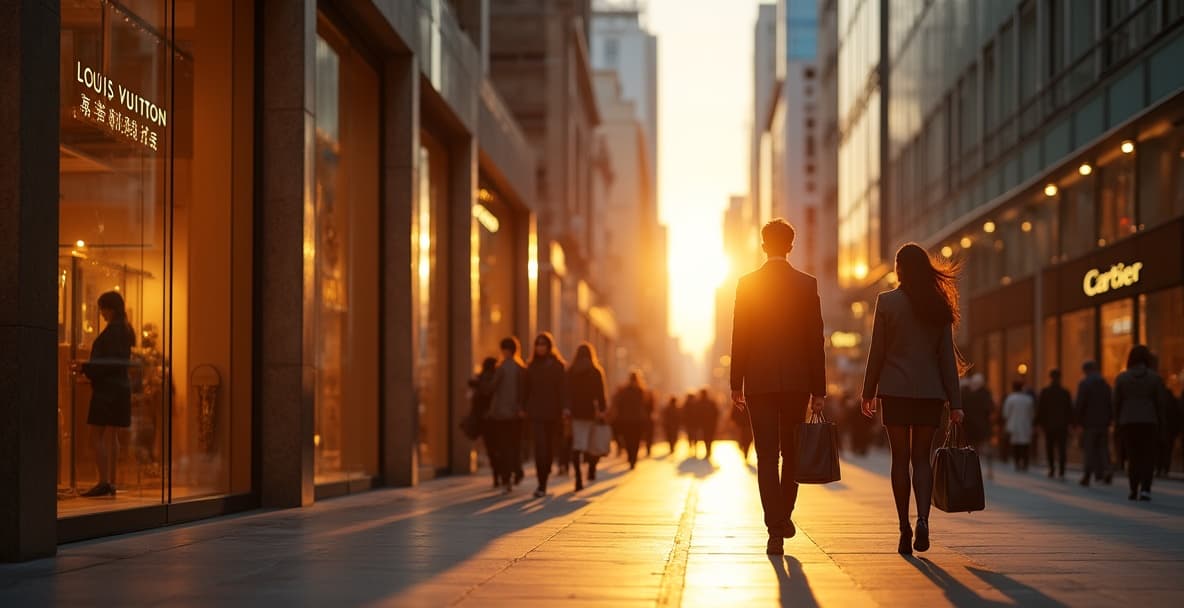
Luxury Sector Under Pressure: China's Consumer Spending Weakens – LVMH and Richemont in Focus
This article was created with the help of artificial intelligence.
Key Takeaways
The luxury goods sector is undergoing a consolidation phase. After 2024 and 2025 saw some luxury stocks come under considerable pressure, volatile sideways and downward movements have continued through 2026 so far. However, since June 2026, signals of a turnaround have been emerging from China – albeit at a lower level than in the boom years.
Key Takeaways
- Louis Vuitton and Burberry have recorded sales growth in Chinese stores again since June 2026, after years of weak demand burdened the sector.
- Combined sales of the ten leading luxury brands on Tmall and Taobao with product prices above 200 yuan grew 39 percent in the first four months of 2026.
- Bain & Company estimates moderate growth of 3–5 percent for the Chinese luxury market in 2026, supported by a growing middle class and government consumption stimulus measures.
- The US luxury market shows resilience: McKinsey and Bain forecast 4–6 percent growth for 2026.
- High-end luxury demonstrates remarkable resilience, while entry-level brands suffer from purchasing restraint among the upper middle class.
- The Indian luxury goods market is growing at approximately 10 percent annually – the Indian upper class could become one of the most important buyer groups by 2030.
China: First Recovery Signals After Years of Weakness
Chinese consumers have shown renewed interest in high-quality cosmetics and fashion products since June 2026. Louis Vuitton and Burberry have recorded sales growth in Chinese stores, while Gucci (Kering) limited declines. Coach (Tapestry Inc.) accelerated its growth. This development marks a turning point after years of weak demand and margin-eroding discount campaigns.
Particularly telling is the development on e-commerce platforms Tmall and Taobao: combined sales of the ten leading brands with product prices above 200 yuan (approximately 25 euros) rose 39 percent in the first four months of 2026. Brands positioned at lower price points, by contrast, recorded slight sales declines.
Daniel Zipser, Senior Partner at McKinsey & Co. in Shenzhen, expressed optimism in June 2026: "For the first time in several years, we are seeing encouraging signals in Chinese consumer spending. The trend is pointing in the right direction."
Gains on Chinese stock markets strengthen the wealth and consumer sentiment of affluent consumers – a factor that has historically favored luxury goods demand.
Forecasts: Moderate Growth Instead of Boom
Bain & Company estimates moderate growth of 3–5 percent for the Chinese luxury market in 2026. The forecast is based on a growing middle class, rising consumer confidence, and government measures to stimulate domestic consumption. The real estate market may have bottomed out, but the era of unbridled consumption has slowed.
For European luxury houses such as LVMH (Louis Vuitton Moët Hennessy) and Richemont (Cartier, Van Cleef & Arpels), this presents a strategic challenge: focus must shift away from pure logo presence toward genuine craftsmanship and cultural relevance. A fundamental shift is evident – the era of logo-dominated, status-oriented consumption is giving way to more conscious purchasing behavior. Chinese luxury consumers in 2026 are seeking quality, heritage, and exclusivity rather than merely recognizable monograms.
Fragmentation: High-End Shines, Entry-Level Falters
Growing fragmentation within the sector is becoming visible. Entry-level luxury suffers from sustained purchasing restraint among the upper middle class, while the high-end segment demonstrates remarkable resilience – which is also reflected in stock prices of corresponding luxury goods companies.
Strong brands and associated pricing power are crucial for success. Brands positioned in the upper price segment that maintain their exclusivity benefit from the changed demand structure. The discount cycles that have characterized the sector in recent years are losing momentum – consumers are showing higher willingness to spend on products that promise genuine value.
USA and India as Stabilizing Factors
The US market has proven surprisingly resilient contrary to recession concerns. McKinsey and Bain & Company forecast 4–6 percent growth for the US luxury market in 2026, supported by robust economic development and stable employment.
India is evolving from a mere "future market" to a genuine growth driver. According to the World Bank, India's upper class is growing faster than in any other major economy. The Indian luxury goods market is currently growing at rates of approximately 10 percent per year. According to forecasts, the Indian upper class could become one of the most important buyer groups for European luxury goods by 2030 – supported by the latest EU trade agreement and a young, brand-affine buyer segment.
Risks Remain
Despite recovery signals, the sector remains volatile. Analysts view the weak phase of 2024 and 2025 as merely cyclical correction, with long-term growth drivers intact. External risk factors such as volatile real estate markets and oil price shocks could, however, influence the spending behavior of affluent Chinese consumers.
In October 2025, investment bank Berenberg had warned of the risk of an end to the luxury boom and predicted a halving of growth in China – a warning that does not appear unfounded given current growth rates of 3–5 percent.
China remains the world's second-largest economy after the US and the world's most populous country after India. With annual economic growth of approximately 4 percent, it counts among the world's most dynamic major economies – driven by investment and rising consumption. For luxury corporations such as LVMH and Richemont, the Chinese market remains indispensable, even if the era of double-digit growth rates appears to be over for now.