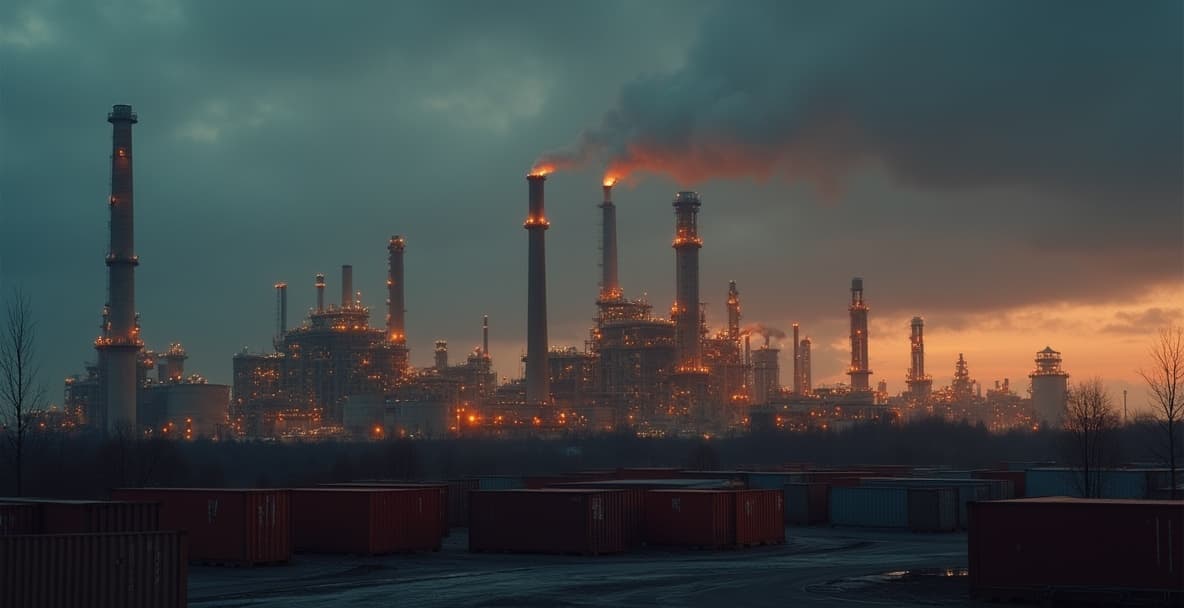
Iran War: Which Industrial Stocks Are Most Affected
This article was created with the help of artificial intelligence.
Key Takeaways
- 90 percent of German industry directly affected by Iran war according to Ifo Institute (survey March 2026)
- Almost 90 percent of companies expect significant business losses, according to the Munich economic research institute
- Energy-intensive industries such as chemicals, metal processing and fertilizer production come under particular pressure
- The IMF characterizes the conflict as a global, asymmetric shock operating through three channels: energy prices, trade and financial conditions
- A survey of more than 700 businesses in North Rhine-Westphalia documents massive burdens from rising transport and energy costs
The Iran war is hitting German industry hard. A current survey by the Munich Ifo Institute shows: 90 percent of German industrial companies are directly affected by the conflict's impact. Klaus Wohlrabe, head of Ifo surveys, explains: "The conflict directly impacts industry, but above all creates great uncertainty."
Almost 90 percent of surveyed companies expect significant business losses, as documented by the Munich economic research institute. A parallel survey of more than 700 businesses in North Rhine-Westphalia confirms the massive burden from rising transport and energy costs as well as strained supply chains.
Key Findings
- 90 percent of German industry directly affected by the Iran war according to Ifo Institute (survey March 2026)
- Almost 90 percent of companies expect significant business losses, according to the Munich economic research institute
- Energy-intensive industries such as chemicals, metal processing and fertilizer production come under particular pressure
- The IMF characterizes the conflict as a global, asymmetric shock operating through three channels: energy prices, trade and financial conditions
- A survey of more than 700 businesses in North Rhine-Westphalia documents massive burdens from rising transport and energy costs
Energy-Intensive Sectors Under Particular Pressure
The chemical industry, metal processing and fertilizer production are among the most severely affected sectors. These energy-intensive industries face additional pressure from the Middle East conflict, which will have long-term effects on the prices of many intermediate products.
The mechanism behind this: Since the EU imports most of its fossil fuels, such a shock effectively acts like a tax on households and companies. Purchasing power decreases, production costs increase – especially for energy-intensive industries, as Simone Tagliapietra from the think tank Bruegel explains to Euronews.
Chemical Sector: Double Burden from Energy and Raw Materials
Chemical companies face a dual challenge: on one hand, energy costs for production are rising, on the other hand, petrochemical raw materials are becoming more expensive. These cost increases can hardly be passed on to customers in the current demand situation.
Metal Processing: Rising Smelting Costs
For metal processing, costs are rising mainly for energy-intensive production steps such as smelting and rolling processes. Added to this are uncertainties in raw material supplies transported via maritime trade routes.
Fertilizer Manufacturers: Multiple Burdens with Consequences for Food Prices
Fertilizer production requires large quantities of natural gas. Rising energy prices hit this sector particularly hard. The federal government has already set up a task force to counter rising food prices – because the war in the Middle East not only raises costs for fuel, but also for energy, fertilizer and transport.
IMF Warns of Global Shock
The International Monetary Fund (IMF) characterizes the Iran conflict as a "global, but asymmetric shock" that operates mainly through three channels: energy prices, trade and financial conditions. The IMF considers disruption to energy supply particularly serious.
"The war is also changing supply chains for everyday goods and critical production inputs," the IMF emphasizes in a recent blog post. This assessment aligns with observations from German companies reporting strained supply chains.
Which Stocks Are Most Affected?
For investors in the DACH region, this brings industrial stocks with high energy requirements into focus for risk assessment. In the DAX, these are particularly chemical companies, steel producers and automotive suppliers with energy-intensive production.
Companies with diversified production facilities should be able to better cushion the burdens than those with concentrated European production sites. The ability to pass energy costs on to customers or to have concluded long-term energy contracts also distinguishes the impact on individual stocks.
Uncertainty as a Central Burden
Beyond direct cost increases, uncertainty is weighing on companies' investment decisions. Klaus Wohlrabe from the Ifo Institute emphasizes that this uncertainty in particular is a central factor. Companies postpone investments when planning certainty is lacking – which further dampens economic momentum.
The combination of rising costs, disrupted supply chains and planning uncertainty is hitting German industry at a time when the economy is already in a difficult situation. The Ifo survey thus documents a burden that extends far beyond individual sectors and affects the entire industrial value chain.
Sources
- Ifo: Iran-Krieg trifft 90 Prozent der deutschen Industrie
- Nahost-Konflikt treibt Kosten in die Höhe: Wie der Iran-Krieg NRW-Unternehmen unter Druck setzt
- Eskalation im Iran-Konflikt: Auswirkungen auf Welthandel und Lieferketten
- Folgen des Iran-Kriegs: Koalition will gegen steigende Lebensmittelpreise vorgehen
- Trotz minimalen Handels: Warum der Iran-Konflikt Europas Wirtschaft trotzdem trifft
- IWF: Iran-Krieg treibt Inflation und bedroht Lieferketten