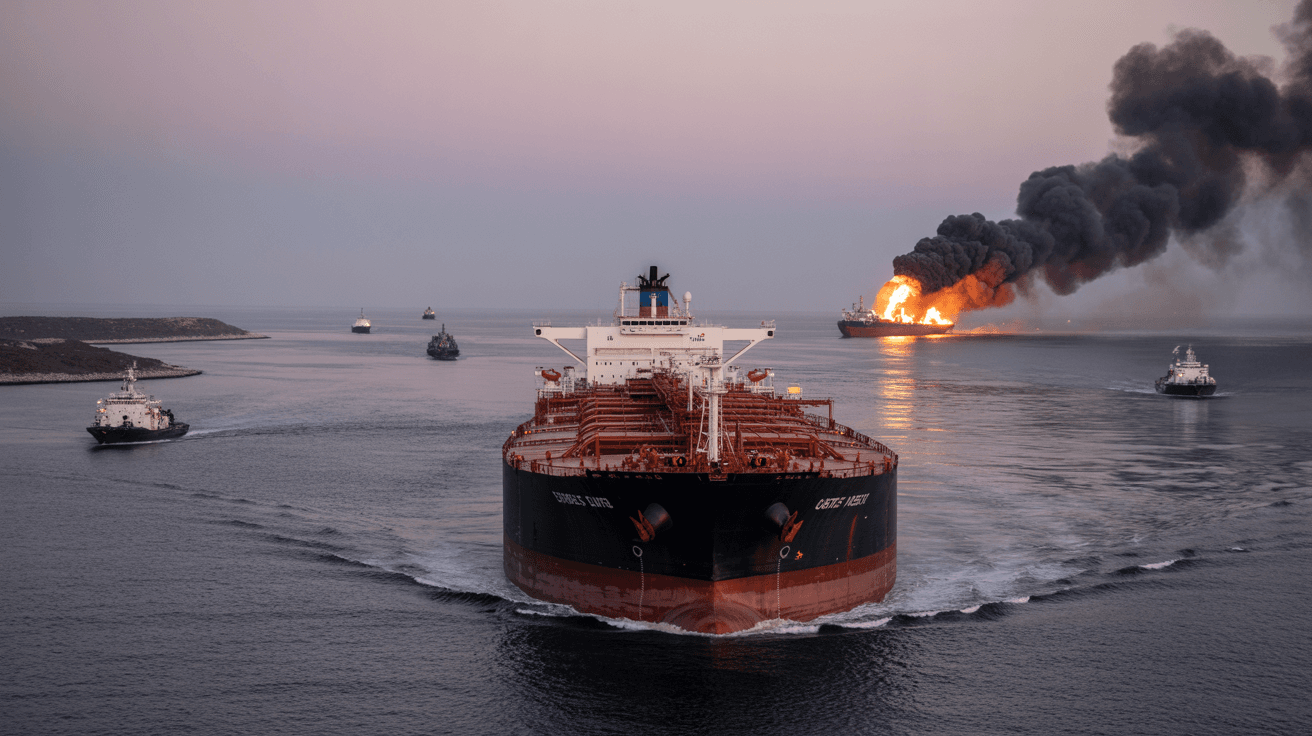
Iran Targets Strait of Hormuz: Attacks on Israel-Linked Tanker – Shipping Stocks React
This article was created with the help of artificial intelligence.
Key Takeaways
- Iran attacks ships in the Strait of Hormuz – a tanker caught fire near Khor Fakkan port after being struck (April 2026)
- Insurance premiums for passage surge to 5–10% of vessel value – for a $100 million tanker, this means up to $10 million per transit
- The Iranian government effectively controls access to the waterway; ships require Iranian permission to pass through
- Iranian Parliament is reviewing a toll for ship traffic through the Strait of Hormuz, estimated at up to $2 million per vessel
- German shipping companies reject toll payments – VDR spokesman Carsten Duif states member companies would neither pay nor transit under these conditions
- The US military is consulting on escort strategies for tankers, while Donald Trump warns Iran of consequences "on an unprecedented scale
Iran carried out a series of attacks on ships in the strategically important Strait of Hormuz over the weekend. A tanker caught fire after being hit near the port of Khor Fakkan, according to reports from April 5, 2026. The Iranian government now effectively controls access to the strait – ships require Iranian permission to pass through.
Insurance premiums spike to record levels
The escalation is hitting the shipping industry hard. According to Euronews, insurance premiums for passage through the Strait of Hormuz have risen to 5 to 10 percent of vessel value. For a Very Large Crude Carrier (VLCC) – a supertanker worth around $100 million – this means additional costs of up to $10 million per transit.
For comparison, before the conflict began, insurance premiums were significantly lower. The US government has put in place a $20 billion reinsurance agreement to ease the shortage of affordable insurance, as reported by Die Zeit. Nevertheless, insurers are increasingly withdrawing coverage or demanding prohibitively high premiums.
Iran considers toll – German shippers reject it
In addition to military risks, a further financial burden looms. According to news agency ISNA, an Iranian parliamentarian stated that Parliament is considering levies on ship traffic through the Strait of Hormuz. The toll is estimated at up to $2 million per vessel.
German shipping companies have rejected the proposal. Carsten Duif, spokesman for the Association of German Shipowners (VDR), made clear: "VDR member companies would not consider paying a toll or passage under these conditions." The conditions are unclear and non-transparent, and one cannot rely on safe passage. This creates a high degree of uncertainty that is difficult for shipping to calculate.
Only Iran-linked tankers now pass through the strait
Data analysis shows that most fully loaded tankers still passing through the waterway are connected to Iran or have direct authorization from Iranian authorities. Shipping companies are increasingly avoiding the waterway, as reported by Tagesschau. Ships are queuing up before the Strait of Hormuz, either detouring to alternative routes or waiting for de-escalation.
The Strait of Hormuz is one of the world's most important shipping routes – approximately one-third of globally traded crude oil passes through the only 55-kilometre-wide strait between the Persian Gulf and the Gulf of Oman.
Reports of mining and military escalation
Recent reports suggested that Iran may have begun mining the strait. US President Donald Trump warned Iran it would face consequences "on an unprecedented scale" if it places explosives in the Strait of Hormuz. However, Trump emphasized that there is currently no evidence that Iran has already done so.
The US military is currently consulting on how to best escort tankers through the strait. Military escort of commercial vessels would further escalate tensions in the region and could additionally destabilize the already tense security situation.
Impact on shipping stocks and oil prices
The uncertainty is weighing on shipping stocks, while experts expect a massive surge in oil prices. Shipping companies face a choice between prohibitively expensive insurance premiums, uncertain passage rights, and long alternative routes around the Cape of Good Hope, which means several weeks of additional sailing time.
For investors, the situation presents a complex picture: While tanker shipping companies could benefit from higher freight rates on alternative routes, rising insurance costs and reduced volumes burden margins. At the same time, a shortage of oil supply is likely to drive prices – with corresponding effects on energy-intensive industries and consumers in the DACH region.
Sources
- 3 Tanker der staatlichen iranischen Reederei verlassen die Straße von Hormus mit 5 Millionen Barrel Öl - FOCUS online
- Schiffe brauchen iranische Genehmigung für Hormus-Passage, Risiken und Versicherungsprämien steigen | Euronews
- Dutzende Schiffe attackiert: Iran legt für die Wirtschaft lebenswichtige Straße von Hormus faktisch lahm
- Nach Angriffen auf Schiffe in Straße von Hormus: Anstieg von Ölpreis erwartet | tagesschau.de
- Straße von Hormus: Welche Auswirkungen hat der Krieg im Nahen Osten auf die Schifffahrt? | DIE ZEIT