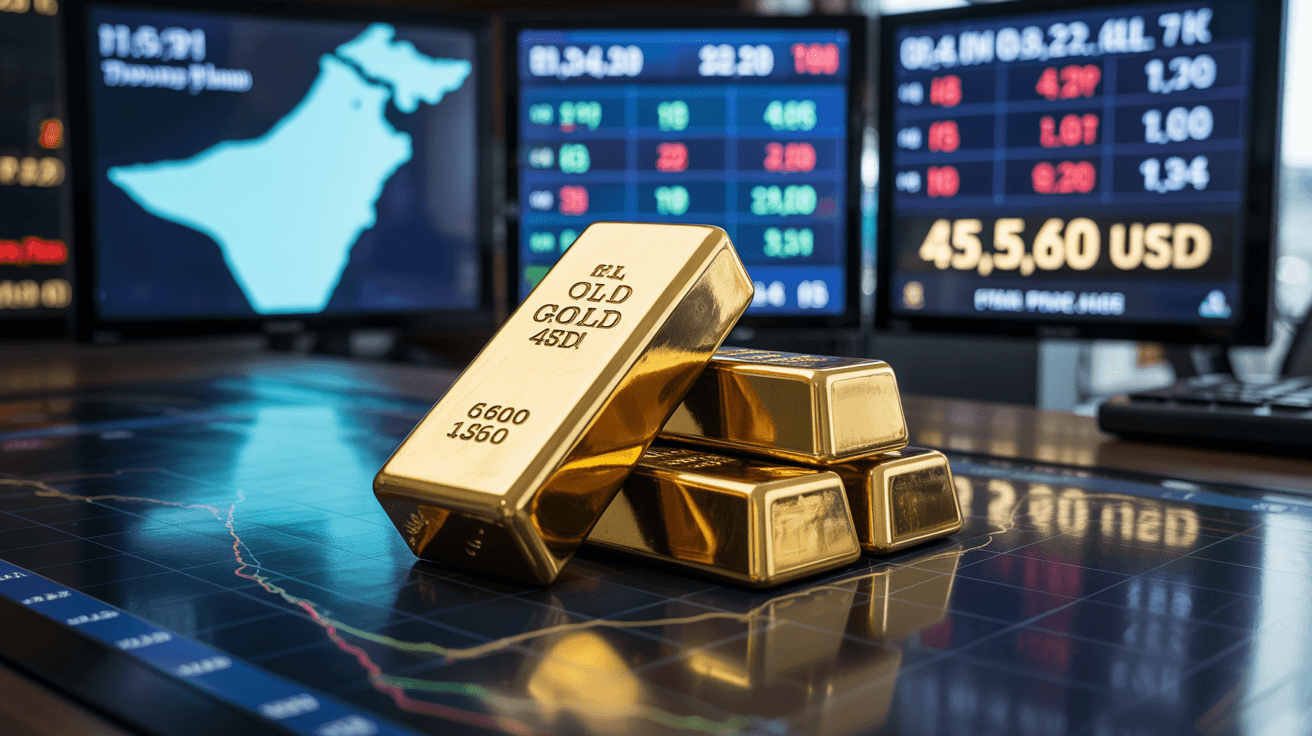
Gold as Safe Haven: Middle East Escalation Drives Precious Metals Demand
This article was created with the help of artificial intelligence.
Key Takeaways
- Spot gold prices stand at around 4,560 US dollars in early April 2026 and show remarkable stability despite escalation in the Middle East
- Iran's blockade of the Strait of Hormuz driven by the Iran conflict pushed oil prices temporarily well above 80 US dollars per barrel
- Analysts speak of a "Macro Override" – gold no longer reacts automatically to geopolitical crises as it did years ago
- Gold prices today are determined by a complex interplay of interest rates, inflation, dollar exchange rates and capital flows
- Over the past 12 months, the gold market has already experienced spectacular price peaks due to persistent global tensions
Key Takeaways
- Spot gold prices stand at around 4,560 US dollars in early April 2026 and show remarkable stability despite escalation in the Middle East
- Iran's blockade of the Strait of Hormuz driven by the Iran conflict pushed oil prices temporarily well above 80 US dollars per barrel
- Analysts speak of a "Macro Override" – gold no longer reacts automatically to geopolitical crises as it did years ago
- Gold prices today are determined by a complex interplay of interest rates, inflation, dollar exchange rates and capital flows
- Over the past 12 months, the gold market has already experienced spectacular price peaks due to persistent global tensions
Military Escalation Shakes Energy Markets
Military escalation between the US, Israel and Iran has thrown financial markets into a phase of heightened uncertainty. The blockade of the Strait of Hormuz – one of the world's most important energy transport routes – due to the Iran conflict has led to sharp increases in energy prices (Source: Pro Aurum Newsroom). Oil prices jumped temporarily well above 80 US dollars per barrel. At the same time, stock markets came under pressure.
The geopolitical situation remains complex: In addition to current tensions in the Middle East, conflicts in the Indo-Pacific, strained relations between Russia and the West, and political instability in various regions shape market developments. These uncertainties are closely monitored by central banks such as the European Central Bank.
Why Gold No Longer Reacts Automatically to Crises
Normally, geopolitical tensions drive precious metal prices upward. However, the recent escalation in the Middle East triggered a chain reaction that analysts call a "Macro Override" (Source: Kapitalmarktexperten.de). Spot gold prices stand at around 4,560 US dollars in early April 2026 and remained remarkably stable despite escalating tensions (Source: ad-hoc-news.de).
This development contradicts traditional reaction patterns. Gold traditionally responds sensitively to any escalation: headlines about new attacks, sanctions or military threats almost reflexively trigger flows into safe havens. During economic uncertainty, people behave predictably and seek safety – gold has been used for more than a thousand years and retains its value (Source: The Patriot).
The Complex Interplay of Price Factors
Reality shows: gold no longer reacts automatically whenever uncertainty emerges somewhere in the world. Its price is determined by a complex interplay of interest rates, inflation, dollar exchange rates, capital flows and geopolitical risks (Source: GranValora). Anyone who views gold solely as crisis insurance easily misses the nuances that move the market.
Over the past 12 months, the gold market has already experienced spectacular price peaks. Persistent conflicts in the Middle East, tensions in the Indo-Pacific and an increasingly polarized world politics influence market developments (Source: n-tv.de). Nevertheless, the overlay of macroeconomic factors currently prevents the classic crisis reaction.
Geopolitics as a Persistent Factor – But Not as the Sole Price Driver
Whether conflicts in the Middle East, tensions in the Pacific region or ongoing uncertainty in Eastern Europe – geopolitical risks remain a persistent theme in raw materials headlines (Source: ad-hoc-news.de). The primary dynamics in the gold market are currently dominated by geopolitical risks, but these no longer act in isolation.
The current stability of gold prices at around 4,560 US dollars despite Iran escalation shows: markets have already priced in part of the uncertainty, or other macroeconomic factors overlay the geopolitical impulses. Investors who view gold as an automatic crisis indicator must adjust their expectations to the new market dynamics.
Outlook: Multipolar Price Determination Persists
Developments in the coming weeks should show whether the stabilization of gold prices holds or whether further escalation in the Middle East will activate classic crisis mechanisms after all. One thing is clear: the era when geopolitical headlines automatically drove higher gold prices appears to be over. Investors must now keep a broader spectrum of influencing factors in view – from interest rate decisions to currency fluctuations to global capital flows.
The current situation underscores the growing complexity of precious metals markets. Gold remains an important component of diversified portfolios, but the rationale for this today lies less in its pure crisis function and more in its role as a stabilizer against a bundle of risk factors.
Sources
- Silber: Geopolitik als Bumerang
- Goldpreis kämpft um Stabilisierung: Spot-Gold bei rund 4.560 USD
- Gold als Krisenbarometer: Wie geopolitische Spannungen den Markt bewegen
- Warum der Goldpreis bei Krisen und Unsicherheit immer steigt
- Gold im Wandel: Warum das Edelmetall nicht automatisch steigt
- Wie geopolitische Risiken Edelmetalle bewegen
- Gold vor der nächsten Fluchtwelle: Riesenchance im Krisenmodus