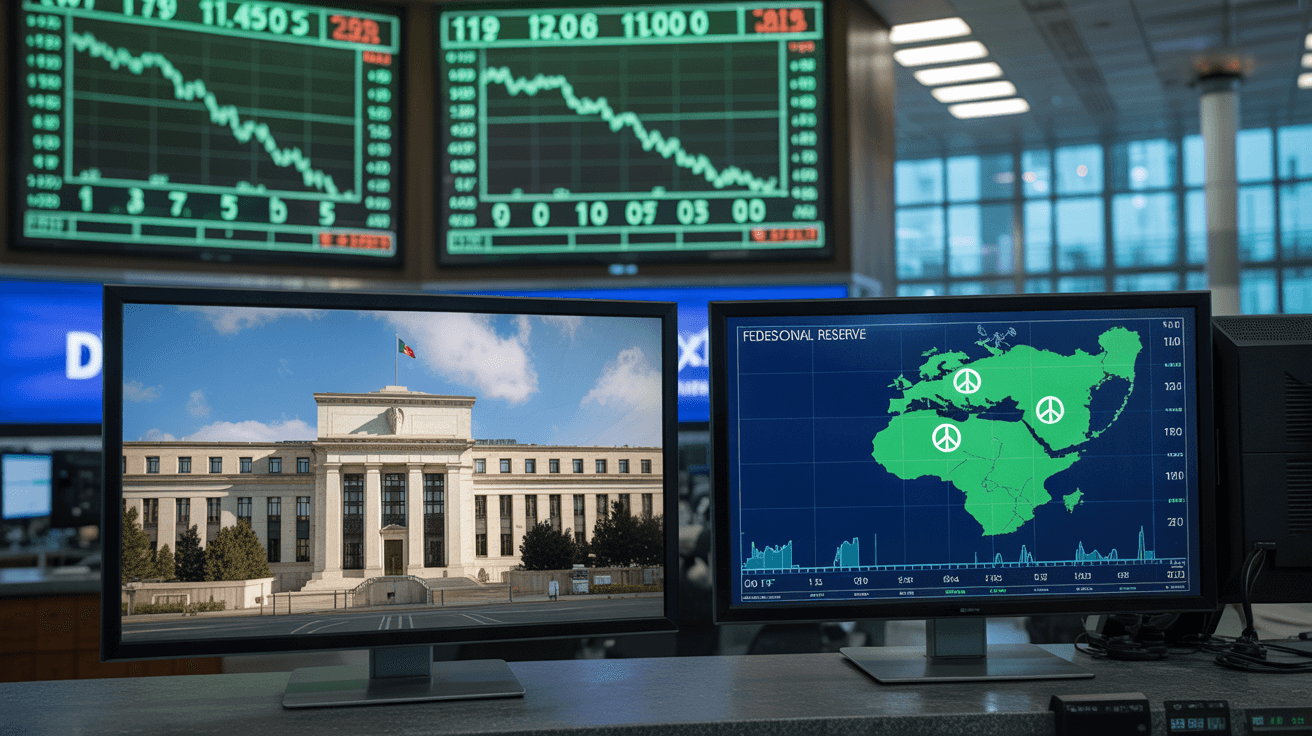
Fed Rate Cut Back on the Table: Iran Ceasefire Changes Interest Rate Expectations
This article was created with the help of artificial intelligence.
The probability of a rate cut by the US Federal Reserve according to the CME's FedWatch Tool currently stands at over 30 percent. The ceasefire in the Iran conflict, which became known in early April 2026, has notably shifted market expectations regarding US monetary policy and is prompting a reassessment of interest rate prospects.
\n\nMiddle East Easing Provides Breathing Room for Markets
\n\nNews of a ceasefire in the Iran conflict has noticeably relieved financial markets. The diplomatic easing led to a sharp decline in oil prices, as concerns about supply bottlenecks in the energy sector diminished. Previously, tensions around the Strait of Hormuz – one of the most important transit routes for global oil transport – had weighed on markets.
\n\nInvestors responded to the changed geopolitical situation with a reassessment of inflation risks. Declining energy prices reduce price pressures in the broader economy and give the Federal Reserve more room for a more accommodative monetary policy. However, the S&P 500 Index showed restraint on April 2, 2026, and fell 0.24 percent to 6,559.65 points – a sign of ongoing investor uncertainty despite positive developments.
\n\nFedWatch Tool Signals Turning Point in Interest Rate Expectations
\n\nThe CME Group's FedWatch Tool, a widely-watched instrument for measuring interest rate expectations based on futures market data, shows a clear shift. With a probability of over 30 percent for a rate cut, market sentiment has changed notably compared to previous weeks. Before the ceasefire, many market participants assumed that the Federal Reserve would keep interest rates largely stable throughout 2026.
\n\nThe Federal Reserve currently holds its benchmark interest rate in a range of 4.25 to 4.50 percent. The benchmark rate is the central bank's primary monetary policy instrument and determines the rate at which commercial banks can borrow money from the central bank. Changes affect credit, savings, and mortgage rates throughout the economy.
\n\nFed Projections Remain Cautious
\n\nThe Federal Reserve's most recent interest rate projections from December 2024 – the so-called "Dot Plots" – foresaw just a single rate cut of 25 basis points for 2026. This assessment was confirmed at the March 2026 meeting. However, there is no consensus within the Fed's policy-making body, the FOMC: Seven of the 19 voting board members advocated for unchanged interest rates in the current year.
\n\nThis caution reflects the Fed's concern that too early an easing of monetary policy could reignite inflation. According to the central bank, the US economy continues to expand at a solid pace, which argues against a rapid policy shift. At the same time, there are signs of a cooling labor market.
\n\nImpact on the DACH Region
\n\nFor investors in the German-speaking region, the changed Fed rate expectations have several implications. On the one hand, US monetary policy significantly influences global capital flows and thus also valuations of European equities. On the other hand, declining US interest rates tend to weaken the US dollar, which moves the EUR/USD exchange rate and impacts exporters in Germany, Austria, and Switzerland.
\n\nMortgage rates in Germany and Austria could also benefit from more accommodative US monetary policy, as global interest rate markets are closely interconnected. However, the interest rate policy of the European Central Bank remains the primary factor for interest rate development in the eurozone. The Swiss National Bank traditionally pursues an independent monetary policy but also reacts to international interest rate developments.
\n\nUncertainty Remains Despite Easing
\n\nDespite positive news from the Middle East, market observers warn against premature optimism. The ceasefire could be fragile, and geopolitical risks remain. US President Trump recently threatened tougher measures against Iran, which could escalate the situation at any time.
\n\nThe next Fed meetings will show whether the central bank will actually use the changed geopolitical situation and falling energy prices as an opportunity to shift its policy. Until then, markets will likely watch every new development in the Iran conflict and every inflation data point closely. The coming weeks will be crucial in determining whether the probability of a rate cut increases further or whether the Fed maintains its cautious approach.