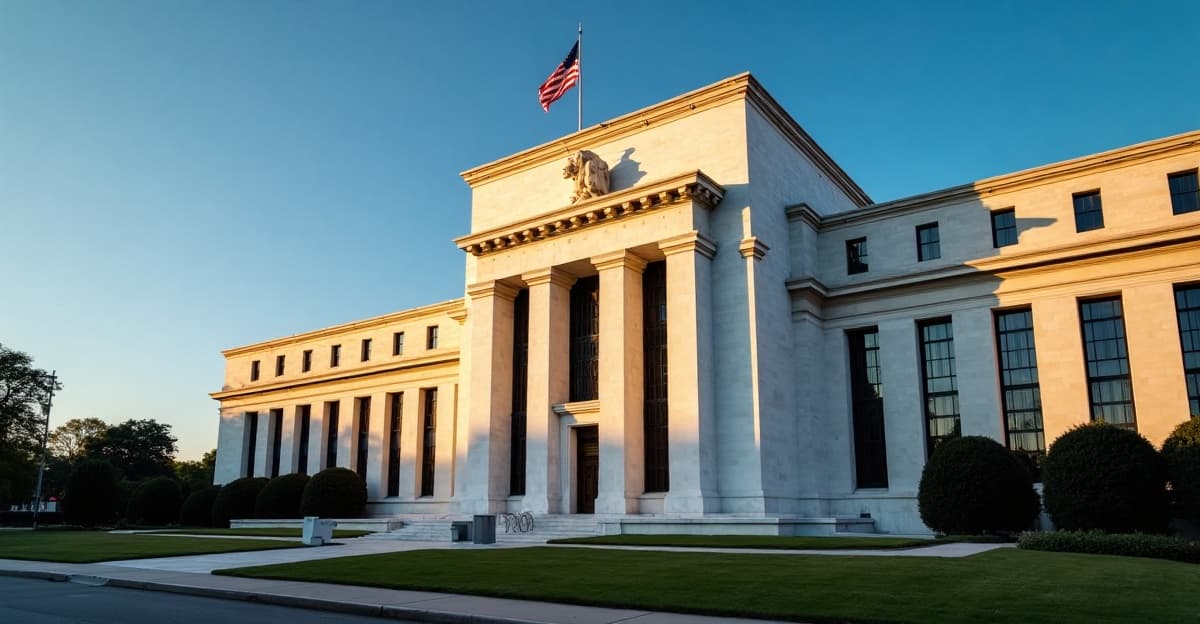
Fed Minutes in Focus: What September Meeting Notes Mean for Tech Stocks
This article was created with the help of artificial intelligence.
Key Takeaways
- The U.S. Federal Reserve unanimously raised the federal funds rate by 25 basis points to 3.75 to 4.00 percent on September 16, 2026, the first rate increase in three years and the first unanimous decision after a previous meeting seven weeks earlier had three dissenting votes.
- The Nasdaq Composite reached a record high on September 23, 2026, despite the rate increase and closed the week on September 25 with a gain of 2.1 percent, while the Dow Jones remained virtually unchanged.
- On September 18, 2026, two days after the Fed decision, the technology sector XLK rose around 2.2 percent, Intel gained around 7.7 percent, and AMD around 6.4 percent.
- The yield on 10-year U.S. Treasury securities reached around 5.23 percent on September 25, 2026, the highest level since 2007, after exceeding the 5 percent mark for the first time in a long time on September 21.
- Massive investments in artificial intelligence are cited as the main driver of the tech stock rally, with Nvidia reaching a market capitalization of around $5.76 trillion with a price gain of 2.1 percent.
- The University of Michigan Sentiment Index fell to a four-month low of 48.1 points, while consumer inflation expectations for the coming year rose to 4.6 percent.
On Wednesday, October 7, 2026, at 8 p.m., the U.S. Federal Reserve will release the minutes from its meeting on September 15 and 16. Investors and analysts are hoping for clues about how determined the Federal Open Market Committee (FOMC) will be in raising interest rates further – a question that is particularly significant for tech stocks.
Unanimous Rate Hike After Three-Year Pause
On September 16, 2026, the FOMC, chaired by Fed Chair Kevin Warsh, unanimously raised the federal funds rate by 25 basis points to a range of 3.75 to 4.00 percent. It was the first rate increase since July 2023 and passed with a 12-0 vote – a clear signal of unity after the previous meeting seven weeks earlier had recorded three dissenting votes.
The move was justified by persistently high inflation and rising oil prices. Fed Chair Warsh emphasized in September 2026 that the committee "will deliver price level stability." Analysts interpreted this statement as shifting the market debate from the question "Will the Fed raise rates?" to "How high can rates go?" – and saw in it an increased risk of another rate hike in October.
Tech Stocks Withstand Rising Rates
Despite the restrictive monetary policy, tech stocks showed remarkable resilience in September. The Nasdaq Composite reached a record high on September 23, 2026. On Friday, September 25, the index gained another 0.5 percent and closed the week at 27,068.72 points with a gain of 2.1 percent.
This development contrasted with other indices: the S&P 500 gained just over 1 percent that same week, while the Dow Jones Industrial Average closed virtually unchanged. The divergence points to an increasing concentration of market gains in a few large technology stocks.
Chip Makers and AI Beneficiaries on the Rise
On September 18, 2026, just two days after the Fed decision, the technology sector ETF XLK rose around 2.2 percent. Chip makers performed particularly strongly: Intel gained around 7.7 percent, AMD around 6.4 percent. Nvidia also posted a gain of 2.1 percent and reached a market capitalization of around $5.76 trillion. Microsoft, Meta Platforms, and Tesla also reported gains.
AI Euphoria as Key Driver
The primary driver of the technology sector's resilience is said to be massive investments in artificial intelligence. Companies that are leaders in AI infrastructure, software, and services continue to attract capital. Investors view these firms as growth drivers in an otherwise uncertain macroeconomic environment.
As early as December 9, 2025, J.P. Morgan Global Research had issued a positive assessment for global equities in 2026, expecting double-digit gains and a resilient global economy in which AI investments determine market dynamics.
Bond Markets Under Pressure
Parallel to rate increases, bond markets came under significant pressure. The yield on 10-year U.S. Treasury securities exceeded 5 percent for the first time in a long time on September 21, 2026. On September 25, it reached around 5.23 percent, the highest level since 2007.
This development increases financing costs for companies and consumers worldwide. Higher real interest rates – that is, inflation-adjusted rates – make bonds more attractive as an asset class and could redirect capital away from equities over time. For growth-oriented tech stocks, whose valuations depend heavily on future cash flows, this increases valuation risk.
Global Central Banks Follow Suit
The Fed is not alone in tightening: the European Central Bank (ECB) raised its policy rates by 25 basis points on September 10, 2026. The Bank of Japan (BoJ) also took a rate step in September. The synchronized tightening of monetary policy across the major economic regions intensifies global pressure on growth stocks.
Consumer Sentiment Plunging
The downside of rate tightening is evident in consumer sentiment. The University of Michigan Sentiment Index fell to a four-month low of 48.1 points. Consumer inflation expectations for the coming year rose to 4.6 percent. Higher financing costs, particularly on mortgages and consumer credit, are increasingly burdening households.
Market Concentration as Risk Factor
Analysts point to a key risk: the concentration in a handful of tech giants increases the vulnerability of the overall market. In an environment of rising real interest rates, a correction in leading AI stocks could weigh on the entire market. Investors should closely monitor capital flows and possible sector rotations to better assess risks in this "higher for longer" rate environment.
Other Important Dates in October
In addition to today's release of the Fed minutes, other important dates are coming: on October 14 at 2:30 p.m., U.S. consumer prices for September will be released – a crucial indicator for future monetary policy. On October 28 at 7 p.m., the Fed's next rate decision follows. At meetings in March, June, September, and December, the central bank also releases its Summary of Economic Projections ("Dot Plot") with updated forecasts. The next Dot Plot appears at the December 2026 meeting.
Today's meeting minutes should reveal how individual FOMC members assess the balance between fighting inflation and growth risks – and thus also how long the AI-driven tech rally can withstand the headwind of rising rates.
Sources
- KI-Euphorie treibt Tech-Aktien - Doch steigende Realzinsen könnten bremsen
- Fed erhöht Zinsen, doch KI-Aktien und fallende Ölpreise stützen den US-Markt
- Fed Zinsentscheid 2026: FOMC-Termine, Leitzins & Prognose
- Fed-Zinserhöhung: Kann die KI-Rallye steigenden Zinsen und einer flacheren
- Tech-Aktien trotzen Fed-Zinserhöhung: KI-Boom treibt SPY trotz Straffung
- Fed-Termine 2026: Alle FOMC-Sitzungen und Zinsentscheide
- US-Futures stabil nach Nasdaq-Rekord – Wetten auf Fed-Zinserhöhung sinken Von Investing.com
- Fed-Protokoll heute Abend: Diese DAX-Aktien hängen am US-Zins Von Investing.com
- Fed-Protokoll am Mittwoch erwartet: Signale für Zinserhöhungen im Fokus - Nachrichten und Statistiken - IndexBox
- Geldpolitische Beschlüsse vom 10. September 2026 (Deutsche Bundesbank / EZB)