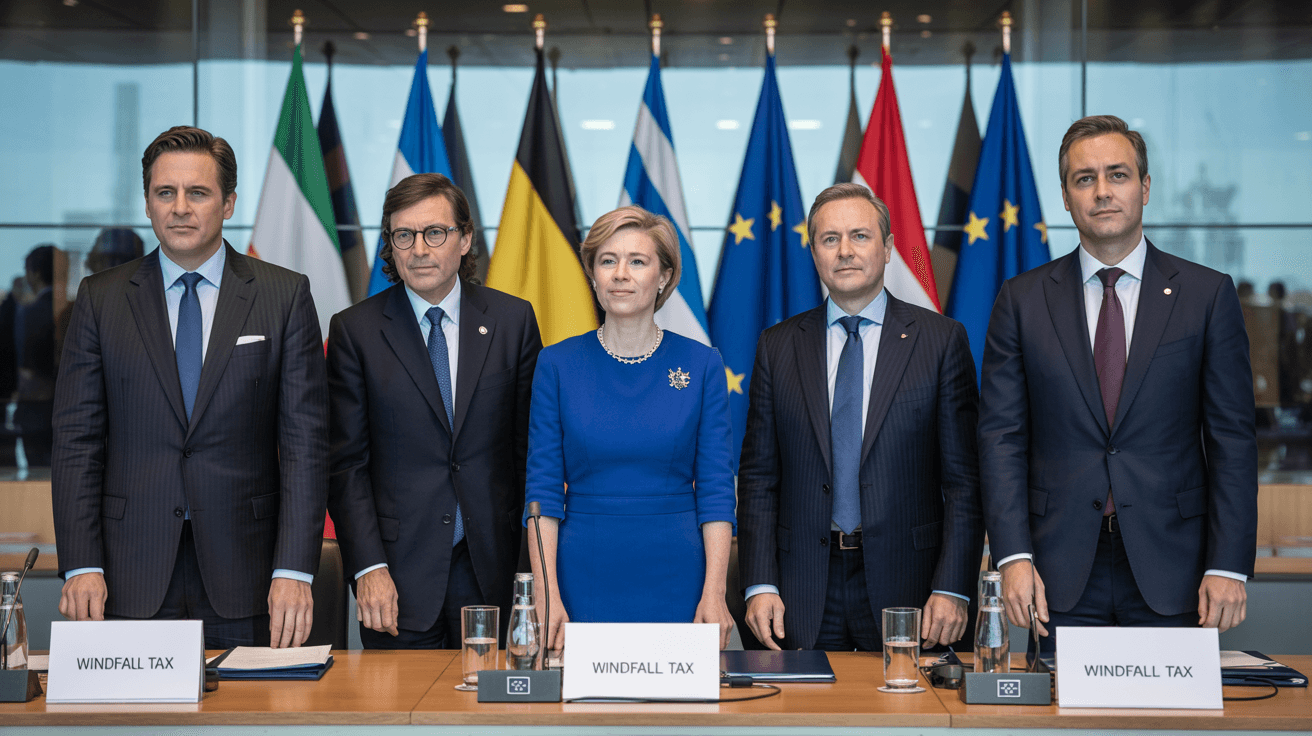
EU plans windfall tax on energy companies: Five nations demand surcharge
This article was created with the help of artificial intelligence.
Key Takeaways
- Finance ministers from Germany, Italy, Spain, Portugal and Austria are calling for a solidarity levy of at least 33 percent on windfall profits of energy companies.
- The special tax is intended to cover oil and mineral companies, coal and gas companies, and refineries.
- Windfall taxes on energy companies have already been introduced in other EU countries.
- The demand was first raised by the Left and Greens in 2022 and has become a central topic of political debate again in 2026.
- In Germany, the question of a windfall tax reveals a rift across the federal government.
Finance ministers from Germany, Italy, Spain, Portugal and Austria are calling for the introduction of a surcharge on windfall profits of energy companies, according to a Reuters report. The five EU member states propose a solidarity levy of at least 33 percent that would be paid to the state.
Which companies would be affected by the energy surcharge?
The planned measure targets three groups of companies in the energy sector:
- Oil and mineral companies
- Coal and gas companies
- Refineries
The levy is intended to specifically target those companies that have profited disproportionately from rising energy prices. The geopolitical crises of recent years have led to sharply rising energy prices and thus to billion-euro profits in the industry.
From radical demand to political mainstream
What sounded like a radical demand from the Left and Greens in 2022 has returned to the center of political debate in 2026. The windfall tax thus ranks among those economic policy instruments that have moved from the political periphery to the mainstream within just a few years.
The reason for this development lies in persistently high energy prices and the associated burden on households and businesses. While energy companies record record profits, costs continue to rise for consumers and industry.
Experiences from other EU countries
Windfall taxes on energy companies have already been introduced in other EU member states. According to available reports, these measures have worked there and provided the state with additional revenue. The five finance ministers can thus draw on practical experience within the European Union.
Political divisions in Germany
In Germany, the discussion is controversial. On the question of a windfall tax, a rift appears across the federal government. Different parties and ministries hold different positions on the special tax, which complicates a unified German position at EU level.
Supporters argue on grounds of social justice and the necessity of taxing extraordinary profits that do not result from business performance but from external shocks. Critics warn of impediments to investment and legal uncertainties.
Politically attractive, legally risky, economically disputed
The windfall tax operates in the tension field between three dimensions. Politically, the measure appears attractive because it enjoys the support of several EU finance ministers and resonates with the public. The notion that crisis-driven additional profits should be taxed more heavily finds broad approval.
Legally, however, implementation presents a challenge. There are legal concerns about the definition of windfall profits, the distinction from regular profits, and compatibility with European competition law. A solidarity levy (a time-limited special tax collected in addition to regular corporate taxation) requires a precise legal basis.
Economically, the effects remain disputed. While some point to additional state revenues and fairer distribution of crisis burdens, others warn of negative effects on investments and locational attractiveness. The question of whether such a tax is actually borne by the company or can be passed on to consumers remains open.
Next steps at EU level
The initiative of the five finance ministers puts the EU Commission under pressure. Germany, Italy and Spain are among the economically strongest member states of the Union. Together with Portugal and Austria, this group represents considerable political weight within the EU.
Whether the demand will result in a concrete legislative proposal remains to be seen. A Europe-wide regulation would require the approval of all member states, which represents a high hurdle given differing national interests. Alternatively, individual member states could pursue national solutions, though this carries the risk of competitive distortions in the internal market.