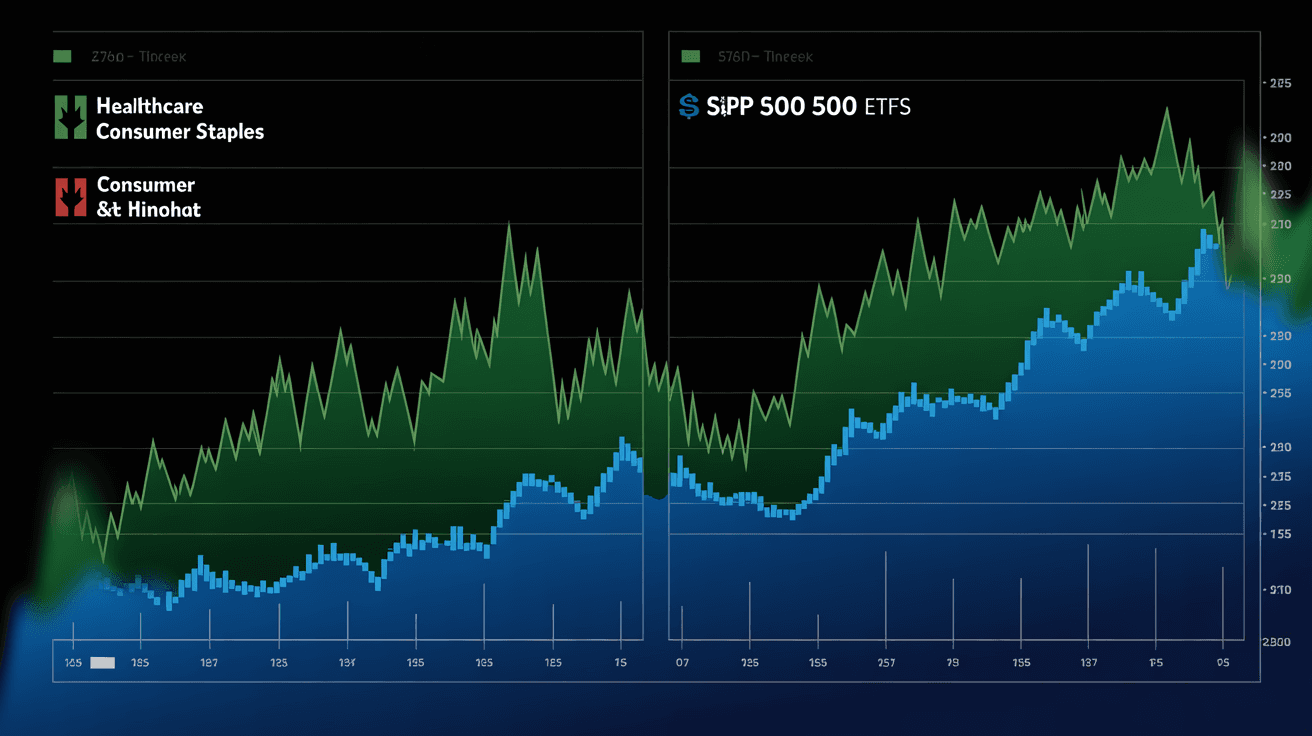
Defensive ETFs Outperform S&P 500: Is a Portfolio Allocation Worthwhile?
This article was created with the help of artificial intelligence.
Key Takeaways
- Defensive ETFs such as XLV (healthcare), XLP (consumer staples), and XLU (utilities) significantly outperformed the S&P 500 index in 2025.
- Defensive sectors benefit from the fact that their products and services remain in demand even during economically difficult times.
- Defensive investments perform better in bear markets but can lag behind the broad market in pronounced bull markets.
- Currency risk is relevant for DACH investors, as the mentioned ETFs are primarily quoted in US dollars.
- Individual risk tolerance and investment horizon are crucial: investors approaching retirement benefit more from a more defensive orientation than long-term investors.
The debate over defensive investment strategies is gaining momentum: Over the past twelve months, the three largest aerospace and defense ETFs have outperformed the broadly diversified Vanguard S&P 500 ETF (VOO) by more than double. For investors in German-speaking regions, this raises the question of whether adding defensive sectors to a portfolio could make sense in the current market environment.
Performance Differences Between Defensive and Broad Market ETFs
The term "defensive sectors" refers to industries whose business models are less cyclical – typically including healthcare, consumer staples, and utilities. These areas benefit from the fact that their products and services remain in demand even during economically difficult times.
The performance data tell a clear story: In 2025, the S&P 500 – represented by the SPY ETF – has underperformed defensive sector ETFs such as XLV (healthcare), XLP (consumer staples), and XLU (utilities). This development is consistent with a market environment characterized by elevated volatility.
What Speaks in Favor of Defensive Positioning?
Morgan Stanley recommended a more cautious positioning throughout the year – with investments that are less susceptible to volatility. The logic behind this: In uncertain market phases, defensive sectors typically offer more stable returns.
Concretely, this means for investors:
- Defensive ETFs typically show higher weightings in healthcare, consumer staples, and utilities than the broad market
- Some of these products pay monthly dividends, which can be attractive for income-oriented investors
- Historical analysis shows: Defensive investments perform better in bear markets but can lag behind the broad market in pronounced bull markets
Classification for DACH Investors
The mentioned ETFs are primarily quoted in US dollars and track American indices. For Swiss investors, this means currency risk against the franc; for investors in Germany and Austria, against the euro. This should be considered in portfolio planning.
An important distinction: Aerospace and defense ETFs – despite the name "Defense" – are not necessarily defensive in the classical sense. They benefit from geopolitical tensions and increased defense spending but do exhibit cyclical behavior.
The decision for or against defensive allocations depends significantly on individual investment horizon and risk tolerance. Those approaching retirement or planning capital needs in the coming years are likely to benefit more from a more defensive orientation than long-term investors with a time horizon spanning decades.