Barnes & Noble Revival 2026: 720 Stores Despite Amazon Dominance – What Retail Investors Can Learn
This article was created with the help of artificial intelligence.
Key Takeaways
- Barnes & Noble operates more than 720 stores in the US in September 2026, after the chain closed over 150 locations since 2008
- CEO James Daunt replaced central control with local assortment decisions by store managers and eliminated publisher advertising revenues for premium placements
- The bookstore chain opened over 60 new locations in 2024 and 28 additional stores in 2026, while Amazon Books had to close all stores by 2022
- According to location analytics firm Placer.ai, customer traffic at Barnes & Noble stores increased by 7 percent since 2019
- In February 2026, Barnes & Noble contacted banks for a potential initial public offering (IPO) following the chain's privatization by Elliott Investment Management in 2019
Barnes & Noble operates more than 720 stores across the United States as of September 4, 2026 – a remarkable expansion for a chain that was forced to close over 150 locations following the 2008 financial crisis and was considered a casualty of Amazon competition. In 2026 alone, the bookstore chain opened approximately 28 new stores, following more than 60 new locations in 2024.
Decentralized Strategy Instead of Corporate Control
CEO James Daunt, who took over following the chain's privatization by Elliott Investment Management in 2019, broke with the previous corporate strategy. The founder of London-based bookstore chain Daunt Books describes himself as a "bookseller" rather than a "retailer" – a distinction that shapes his strategic approach.
Core elements of the reorientation: store managers independently decide on product assortment and store design tailored to their respective communities. The central mandate for uniform product placement was eliminated, as were publisher advertising revenues for premium shelf space. Daunt emphasizes that physical retail can compete with online bookstores as long as diversity and local relevance are provided.
Customer Traffic Up 7 Percent Since 2019
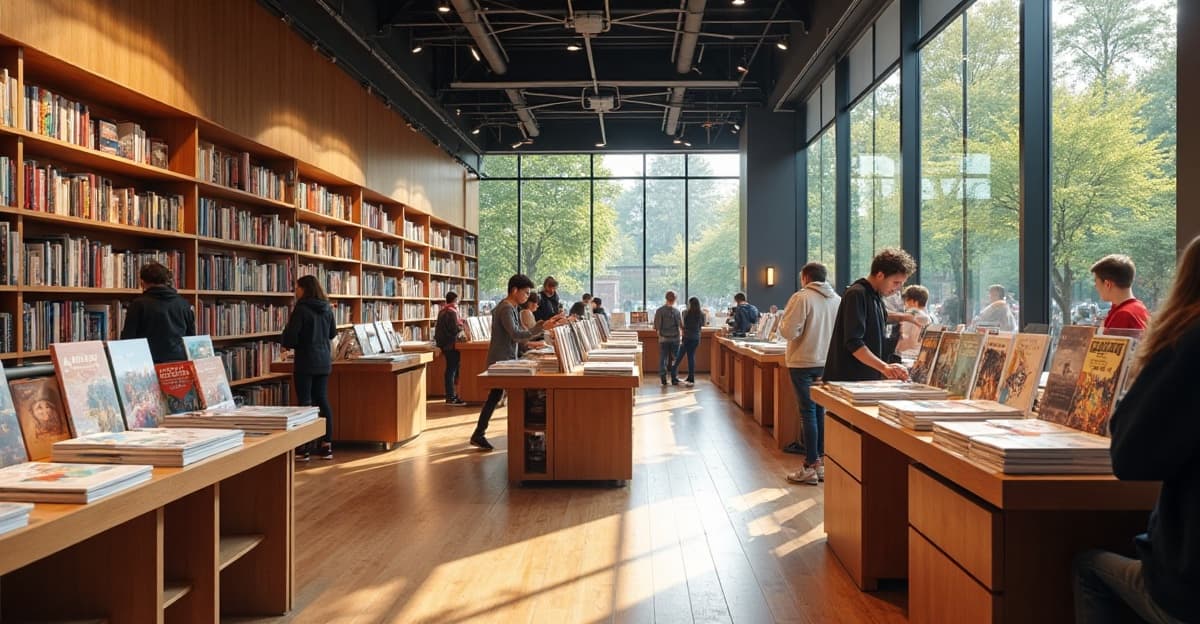
Location analytics firm Placer.ai recorded a 7 percent increase in customer traffic at Barnes & Noble stores since 2019. The product assortment has expanded beyond classic books: vinyl records, Lego sets, and games now complement the shelves. New stores feature brighter designs and follow no uniform concept anymore – the chain now operates various store formats.
New locations frequently occupy properties of former retailers such as Bed Bath & Beyond or Staples. In November 2024, Barnes & Noble symbolically returned to its former flagship store in Georgetown, Washington DC, which had closed in 2013.
BookTok as Growth Driver
The TikTok community BookTok significantly contributed to the company's success, according to statements from January 2026. The platform generates demand for specific titles and drives customers to stores. Barnes & Noble explicitly attributed its expansion plans for 60 new openings in 2025 to "BookTok-driven demand".
In July 2026, Barnes & Noble and independent bookstores reported higher revenues – a "remarkable turnaround" after years of decline due to Amazon's rise. The chain positions its stores as "third places" for communities, beyond workplace and home, with books as the anchor.
Contrast to Amazon Books
Amazon Books, launched in 2015 with a data-driven "rating-first" approach that stocked bestsellers based on website sales figures, failed and closed all locations by 2022. The contrast to Barnes & Noble's curated, locally adapted concept is clear.
The current development reverses the narrative of the 1990s and 2000s: back then, Barnes & Noble was seen as a threat to independent bookstores – the 1998 film "You've Got Mail" thematized this fear. Subsequently, the chain itself experienced disruption by Amazon. Today, Barnes & Noble adopts principles of independent booksellers – local curation, authentic selection – and combines them with the scalability of a large chain.
IPO Plans Following Privatization
In February 2026, Barnes & Noble contacted banks for a possible initial public offering. An IPO would complete the turnaround under Elliott Investment Management, which privatized the chain in 2019. Specific timelines or valuations were not disclosed.
What Retail Investors Can Learn from the Revival
The Barnes & Noble turnaround demonstrates several levers for physical retail in the digital age:
- Autonomy over centralization: Local decision-makers adapt offerings to regional needs better than centralized merchandise management systems
- Curation over algorithm: Human selection can be a differentiator against data-driven online assortments
- Experience over efficiency: Physical spaces as "refuge from modern distractions" with quality of stay rather than pure transaction function
- Social media integration: Platforms like TikTok can generate demand for physical retail when products are experience-oriented
- Flexible real estate concept: Vacant space from other retailers offers expansion opportunities with favorable terms
Daunt emphasizes that the improvement occurred continuously and was based on empowering local booksellers – not on rapid technological fixes or marketing campaigns.
Broader Trend: Online Versus Physical
The distinction "chain versus independent," which shaped progressive political debates in the 2000s, was replaced by the dividing line "online versus physical." Independent bookstores experienced a comeback parallel to Barnes & Noble – both benefit from a shift in customer priorities toward physical shopping experiences.
Barnes & Noble's success is part of a broader reassessment of physical retail by investors. While e-commerce growth was long considered inevitable, concepts with local focus and quality of stay demonstrate resilience. For investors evaluating retail turnarounds, the Barnes & Noble case provides a model: cultural change, operational decentralization, and patient capital rather than short-term return expectations.
Sources
- How America Learned to Love Barnes & Noble Again
- Barnes & Noble is making a comeback
- Barnes & Noble tops 720 stores in major revival
- Barnes & Noble's Comeback: Inside the New Store Strategy
- Barnes & Noble, independent bookstores mount a comeback
- Barnes & Noble plotting comeback in 2026 amid boost from BookTok - Las Vegas Sun News