Asian Stocks Rise After Tech Rally on Wall Street: Nikkei Climbs to 64,622 Points
This article was created with the help of artificial intelligence.
Key Takeaways
- Japan's Nikkei 225 closed on September 4, 2026 with a gain of 1.3% at 65,021 points after climbing to 64,622 points during the session.
- The US economy created an unexpectedly strong 162,000 jobs in August 2026, more than double the 65,000 jobs expected according to FactSet survey.
- Tech stocks on Wall Street posted significant gains on September 4, 2026: SanDisk rose 10.4%, Micron Technology gained 4.6%, and Advanced Micro Devices advanced 4.2%.
- The yield on the two-year US Treasury note climbed to 4.36% on September 4, 2026, signaling a higher likelihood of a Fed rate hike at the September 16 meeting.
- The US inflation rate remains well above 3%, driven by rising oil prices related to the US conflict with Iran, while the Federal Reserve targets 2%.
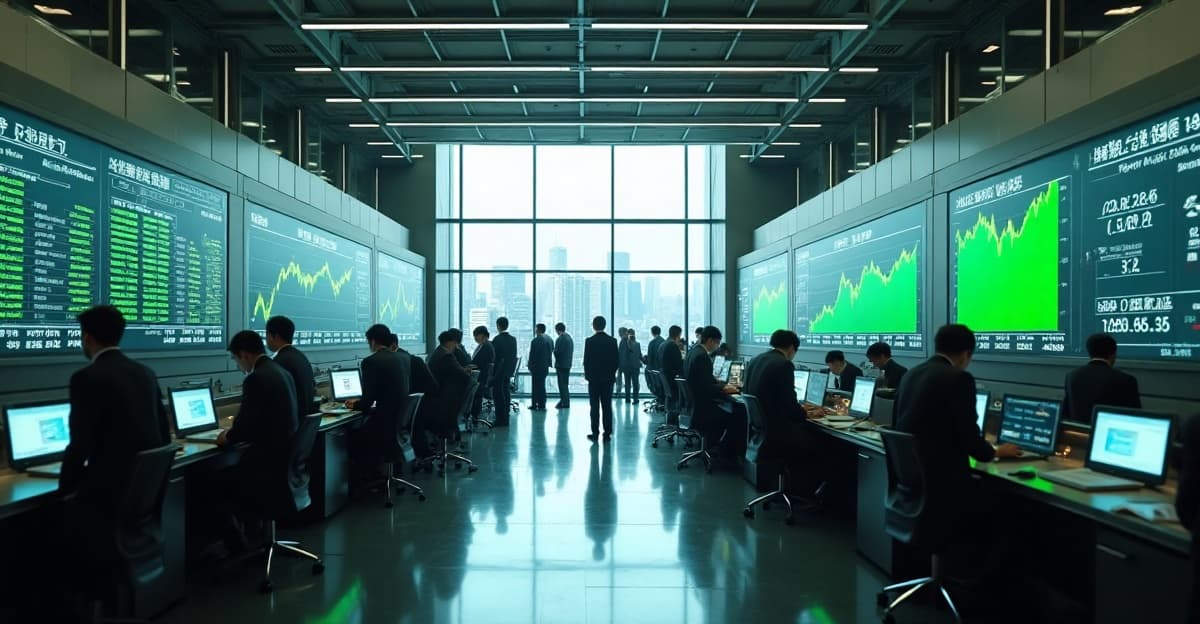
Japan's Nikkei 225 closed on September 4, 2026 with a gain of 1.3% at 65,021 points, after technology stocks on Wall Street posted significant gains. During trading, the Japanese benchmark index climbed 0.6% to 64,622 points before advancing further by market close.
Tech Stocks Drive US Trading Despite Negative Overall Balance
On Wall Street on September 4, 2026, tech stocks delivered strong performance while broad indices closed in the red. The S&P 500 fell 0.3%, the Dow Jones Industrial Average lost 245 points or 0.5%, and the Nasdaq Composite declined 0.2%.
Among the day's winners in the tech sector were several semiconductor and hardware manufacturers. Nvidia rose 1.4%, Advanced Micro Devices gained 4.2%, while SanDisk jumped 10.4%. Micron Technology gained 4.6%.
Sportswear manufacturer Lululemon Athletica, meanwhile, experienced a sharp decline of 17.4% after the company reported quarterly revenues below analyst expectations and lowered its forecast for the current fiscal year.
Strong US Labor Report Significantly Exceeds Expectations
The US Department of Labor announced on September 4, 2026 that the American economy created 162,000 new jobs in August. Economists had expected only 65,000 new jobs according to a FactSet survey. Additionally, the department upwardly revised figures for June and July, adding 55,000 jobs. The unemployment rate remained unchanged at 4.1%.
Terry Sandven, chief equity strategist at U.S. Bank Asset Management Group, stated: "Today's labor report argues for a rate increase by the Fed," but added that an increase was "not a done deal." Jeffrey Roach, chief economist at LPL Financial, assessed the situation more definitively: "Given the strength of the employment report, a rate increase on September 16 appears increasingly likely."
Rate Increase Looms: Inflation Above 3 Percent
The US inflation rate remains well above 3%, driven by rising oil prices related to the US conflict with Iran. The Federal Reserve targets 2% inflation.
In the bond market, yields mostly moved higher following the labor report. The yield on the two-year US Treasury note rose from 4.34% to 4.36% on September 4, 2026. This maturity is particularly sensitive to expectations regarding Federal Reserve policy. At the beginning of 2026, the two-year yield had been at 3.50%.
The yield on the ten-year US Treasury note fell slightly from 4.77% to 4.76%. This bond influences, among other things, mortgage rates and stood at 4.20% at the beginning of 2026.
Mixed Picture at Asian Exchanges
While the Nikkei 225 posted significant gains, developments at other Asian trading venues on September 4, 2026 were mixed. South Korea's Kospi closed with a gain of 1.6% at 6,687 points, though some sources recorded an increase of 1.7% to 6,691 points.
Australia's S&P/ASX 200 performed weaker, declining 0.2% to 9,006 points. Earlier in trading, the index had been nearly unchanged at 9,012 points.
The tech rally on Wall Street provided particular momentum for export-oriented markets in Japan and South Korea, as investors assessed the implications of a robust US labor market for future monetary policy. The tension between sustained strong job growth and the Federal Reserve's efforts to combat inflation through possible rate increases by year-end shaped market sentiment in the region.