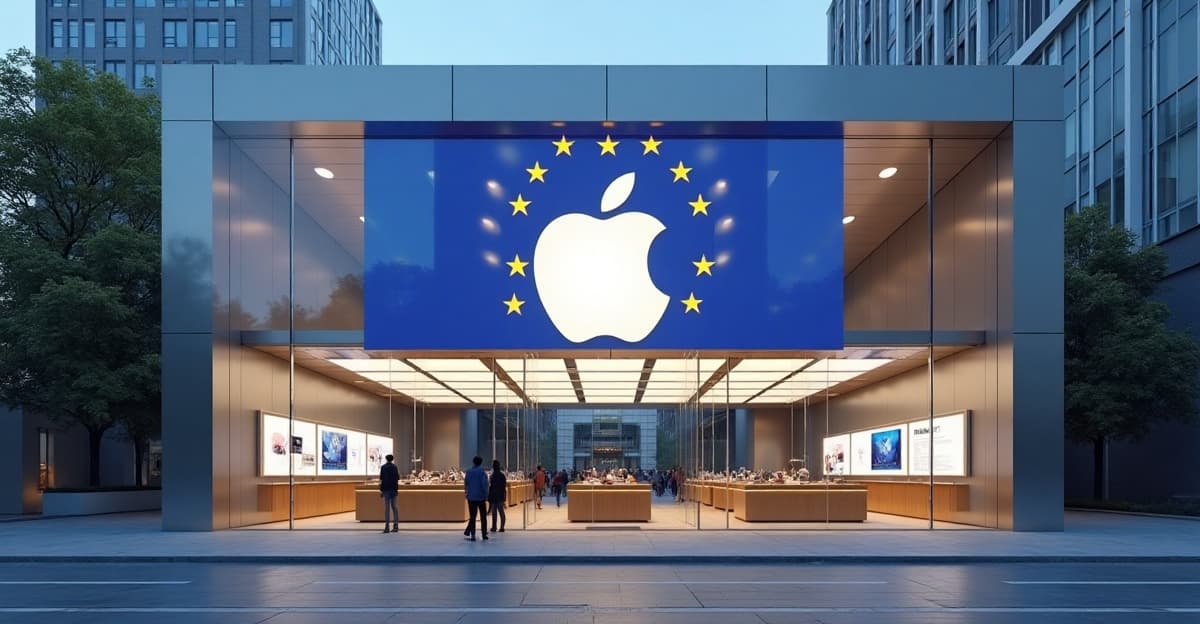
Apple Cuts App Store Fees in Europe: What It Means for Investors
This article was created with the help of artificial intelligence.
Key Takeaways
- Apple announced on August 18, 2026, a reduction of App Store fees in Europe to 5% for payments outside the App Store, which is a direct response to compliance requirements imposed by European antitrust authorities under the Digital Markets Act.
- The European Court confirmed on July 8, 2026, that Apple's App Store and the iOS operating system fall under the provisions of the EU Digital Markets Act, making Apple subject to enhanced compliance requirements.
- The previous standard fee of 15% to 30% – depending on developer status and transaction volume – was considered one of the most important revenue sources in Apple's services segment, while the reduction to 5% is likely to pressure margins in this area.
- Apple stock closed on August 18, 2026, at $310.23 with a gain of 1.52%, while the NASDAQ Composite declined 1.33% on August 19, 2026.
- Apple announced a multi-tiered supply agreement with Broadcom valued at over $30 billion, aimed at strengthening chip production in the United States and reducing supply chain risks.
Apple announced on August 18, 2026, a reduction in App Store fees in Europe to 5% for payments outside the App Store. The fee adjustment is a direct response to compliance requirements imposed by European antitrust authorities under the Digital Markets Act. The stock of the technology company from Cupertino, California, closed on the announcement day at $310.23, up 1.52%.
Court Decision Forces Apple to Adjust
The European General Court confirmed on July 8, 2026, that Apple's App Store and the iOS operating system fall under the provisions of the EU Digital Markets Act. With this decision, Apple is subject to enhanced compliance requirements that the court established in the context of an interoperability complaint procedure. The Digital Markets Act – an EU regulatory framework that came into force in March 2024 – prohibits large technology companies from favoring their own products and services through widely used technologies over competing offerings.
As early as December 16, 2025, a coalition of 20 app developers and consumer associations called on European regulatory authorities to enforce EU laws against Apple's fee practices. The developers criticized the fee structure in effect at that time as anticompetitive.
What the Fee Reduction Means for the Business Model
Apple generates recurring revenue through fees from payments and cloud services with high customer loyalty. The App Store is a central component of the ecosystem, which serves consumers as well as small and medium-sized businesses and education, enterprise, and government markets. The fee reduction in Europe specifically affects transactions processed outside the App Store – that is, payments that developers process directly through their own systems.
The previous standard fee of 15% to 30% – depending on developer status and transaction volume – was considered one of the most important revenue sources in Apple's services segment. The reduction to 5% for alternative payment methods in the EU is likely to pressure margins in this area, with the exact financial impact depending on developer adoption of the new payment options.
Market Reaction and Technical Picture of the Stock
Apple stock (AAPL, NASDAQ) closed on August 18, 2026, at $310.23, a gain of $4.64 or 1.52%. The intraday trading range was between $308.90 and $311.45. The 52-week range was between $300.57 and $311.45, with the price trading near the upper end of the trading band.
On August 18, 2026, AAPL was trading above the short-term (20-day average: $313.16) and medium-term averages (50-day average: $305.42) as well as significantly above the long-term 200-day average of $272.14. The Ichimoku Kijun identified $311.76 as the next key support level.
The technical indicators showed mixed signals: the MACD was at "Strong Buy," while the Average Directional Index (ADX) showed "Buy." However, the Relative Strength Index (RSI) was at 67.59, indicating overbought conditions. Stochastic RSI, Commodity Channel Index, and Bull/Bear Power confirmed the overbought condition, while the Awesome Oscillator remained in buy territory. Analysts expected a short-term trading corridor between $311.94 and $320.42.
Broader Market Developments and Strategic Perspectives
While the NASDAQ Composite declined 1.33% on August 19, 2026, closing at 26,289.71 points, Apple was able to hold its ground against the general weakness on the previous day. The relative strength of the stock suggests that investors do not view the fee adjustment as a fundamental burden – possibly also because the regulatory requirements have been foreseeable for months and may already be priced in.
Parallel to the regulatory challenges, Apple is working on strategic initiatives for product differentiation. The company announced a multi-tiered supply agreement with Broadcom valued at over $30 billion. The partnership aims to strengthen chip production in the United States and reduce supply chain risks. Additionally, Apple is cooperating with PrismML on on-device AI model compression to advance hardware development.
Assessment for Investors
The fee reduction in Europe sets a precedent that could potentially extend to other markets. For investors, the question remains to what extent the reduced fees can be offset by higher transaction volumes or lower compliance costs. Apple emphasizes that its business model is based on economies of scale in research, development, and marketing – an argument aimed at demonstrating long-term profitability despite regulatory intervention.
The technical overbought condition of the stock suggests that short-term profit-taking is possible, especially if negative news or disappointing quarterly earnings follow. In the long term, the question remains how Apple will balance regulatory compliance with the defense of its margin-rich services revenue.