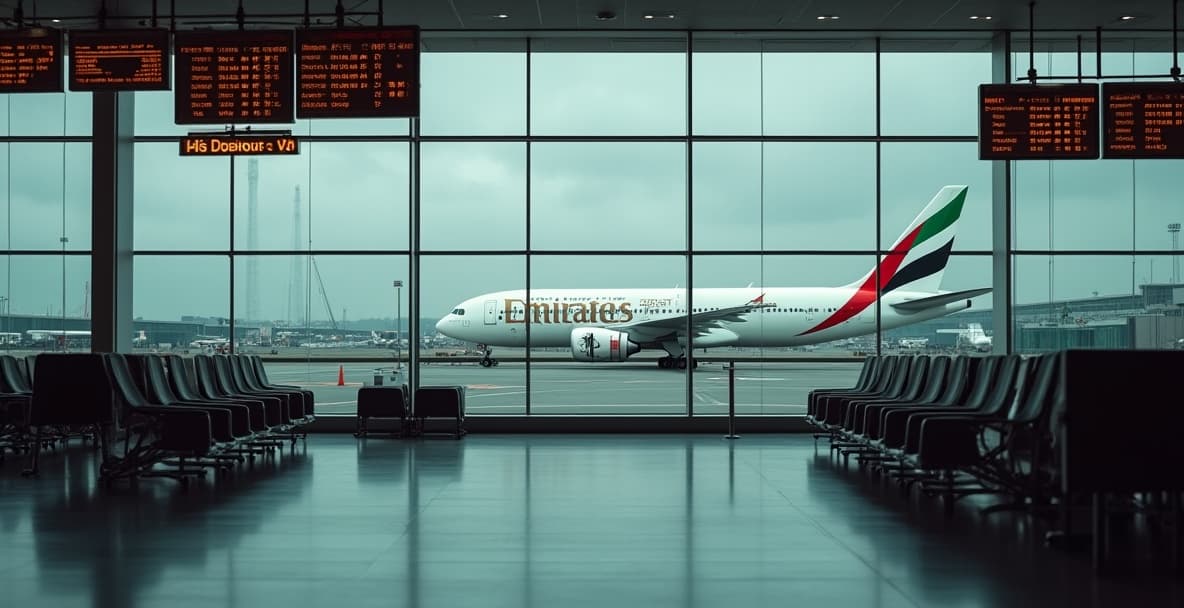
Airlines in Iran Conflict: Emirates Restrictions Hit Airline Stocks
This article was created with the help of artificial intelligence.
Key Takeaways
- Emirates, Etihad Airways and Qatar Airways had to almost completely halt flight operations following the escalation in the Iran conflict in late February 2026.
- The Middle East economy is losing $600 million daily in revenue according to industry figures due to the closure of Dubai and Doha airports.
- Emirates and Qatar Airways face potential losses in the billions, as their hubs as central connecting points between Europe, Asia and Australia are practically unusable.
- IAG stock lost 9 percent of its value, while the DAX fell by 1.6 percent in response to the attacks.
- The closure of central hubs forces international airlines to reroute, which causes longer flight times and higher fuel costs.
- Geographic concentration of Gulf airlines on a few locations in a geopolitically unstable region makes their business models vulnerable.
Dubai and Doha airports have been largely paralyzed since late February 2026 due to escalation in the Iran conflict – Emirates, Etihad Airways and Qatar Airways have had to almost completely halt flight operations. Following the first attacks by the USA and Israel on Iran on 28 February, Iran attacked US military targets in the Gulf states with missiles. The consequences for the aviation industry are severe: according to industry figures, the Middle East economy is losing $600 million daily in revenue.
Which airlines are affected by the Iran conflict?
The crisis hits the state airlines of the Gulf region particularly hard. Emirates from Dubai, Etihad Airways and flydubai from Abu Dhabi as well as Qatar Airways from Doha and Air Arabia are experiencing near-complete operational disruptions. Nearly two weeks after the outbreak of war, airports were closed or only very limited in their use, as Tagesschau reported. The affected airlines are currently losing massive revenues.
Emirates and Qatar Airways – both among the world's largest long-haul carriers – face potential losses in the billions. Each day of war becomes a potential billion-dollar loss for these airlines, as their hubs in Dubai and Doha as central connecting points between Europe, Asia and Australia are practically unusable.
How are the stock markets reacting to the crisis?
Markets showed the typical crisis pattern: massive sell-offs in airline stocks and travel providers. The IAG stock – the holding behind British Airways, Iberia and Aer Lingus – lost 9 percent of its value. The DAX fell by 1.6 percent in response to the attacks. Investors switched to defensive positions and avoided sectors with direct crisis exposure.
European and global airlines also came under pressure, although they are operationally less affected than Gulf airlines. Uncertainty about the further development of the conflict and possible expansion to other regions is weighing on the entire sector.
What financial dimensions does the crisis reach?
The figures illustrate the scale of economic disruption: $600 million daily is being lost to the Middle East economy according to industry representatives. For Emirates, Etihad and Qatar Airways, losses add up to billions within a few weeks. These airlines operate with high fixed costs – parked aircraft, staff on standby and idle infrastructure continue to incur expenses while revenues vanish.
How do analysts assess further developments?
Analysis firm B Riley Securities warned that the active war situation and associated flight disruptions are likely to significantly dampen travel appetite in the region. Even after a possible de-escalation, experts expect a prolonged recovery phase, as passengers may avoid the region for the time being.
For investors, the situation remains volatile. Airline stocks traditionally react sensitively to geopolitical crises – the current situation in the Middle East compounds existing uncertainties. Further stock price movements will depend largely on how the conflict unfolds and how quickly normal flight operations can resume.
What impact does the crisis have on global aviation?
The closure of central hubs Dubai and Doha forces international airlines to reroute. Connections between Europe and Asia must use alternative routes, which causes longer flight times and higher fuel costs. For passengers, this means restrictions on route choices and often significantly more expensive tickets on remaining connections.
Gulf airlines have invested heavily in recent years in their position as global aviation hubs. This strategy proves to be a weakness in the current conflict: geographic concentration on a few locations in a geopolitically unstable region makes business models vulnerable.